
What do a Chinese imperial embroidered cloud collar – vibrant in colours and highly detailed- and a Communist worker suit - monochromatic blue, adorned with a bright red Mao pin - have in common?
Not only are they part of the Chinese collection of the TRC in Leiden, they also give a contrasting reflection of the changes that took place in China over a hundred years, from imperial times to the People’s Republic of China. In addition to their apparent esthetic differences, the two pieces however reveal different political and personal orientations in very graphic manners.
 Early 20th century 'Cloud Collar' from imperial China. TRC 2004.0108).
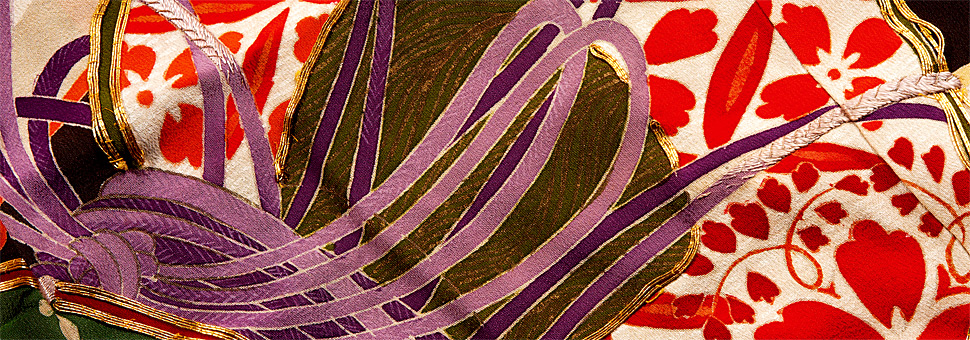
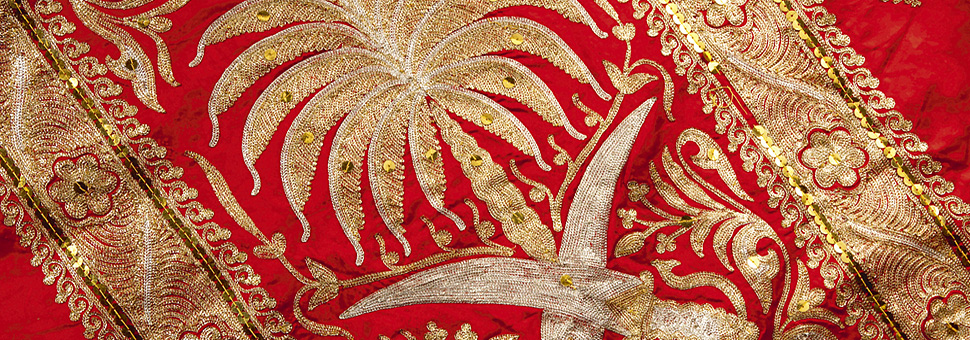
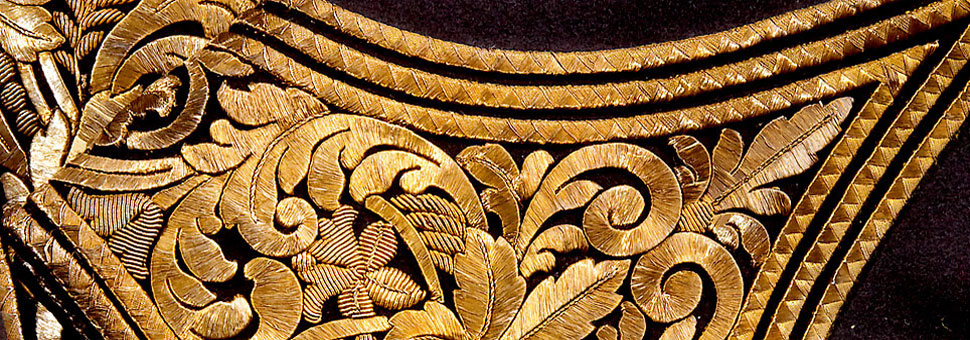
The embroidered collar (TRC 2004.0108) is dated to the early 20th century. Iit is intricately embroidered with flowers and it has multi-coloured tassels. This type of collar is commonly referred to as a “Cloud Collar”, or Yunjian (雲肩) in Chinese, because of its spiralling shape. The cloud motif is common in Chinese cosmology and was already present in bronze mirrors since the Zhou dynasty (1122–221 BC). Originally, the motif symbolised the separation between the material and the spiritual worlds. Progressively loosing its spiritual association, it became more common as an ornamental collar shape during the Qing dynasty (1644-1912) and was mostly worn by women. A photograph of Qing Empress Cixi gives an example of how they were worn at the time.
Details of interest on this piece in the TRC collection are the three embroidered vignettes at the back. Although the Chinese characters that accompany them are faded, they seem to represent characters acting out different types of relationships that one should entertain according to Confucian philosophy at the time: two friends, a man and a woman and lastly a mother and their child. The characters accompanying the images seem to be poetic scripture describing each type of relationship. There is something quite striking about the idea of wearing one’s precepts as images on the shoulders.
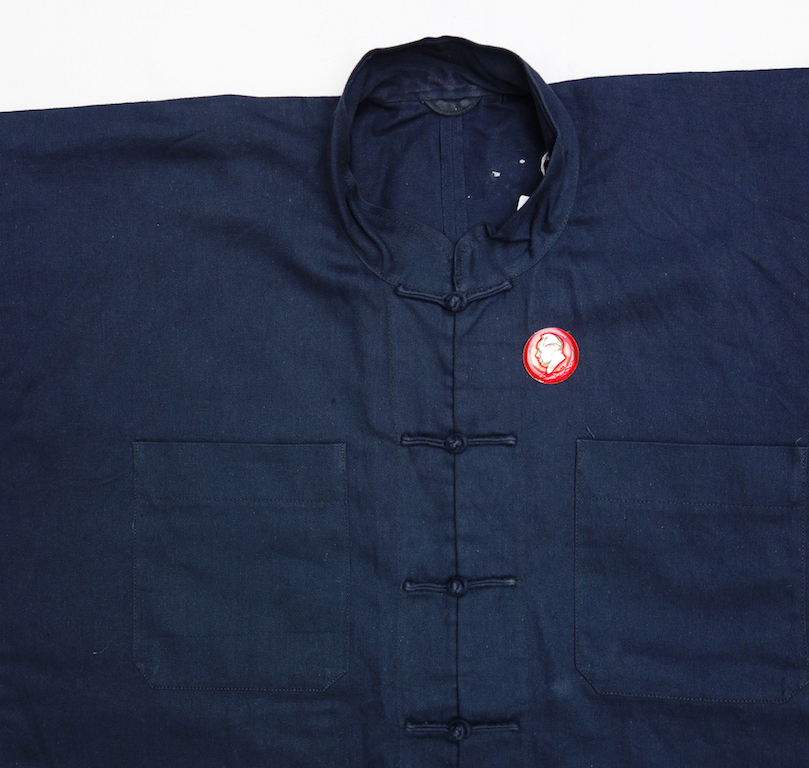 Tunic as part of a so-called Mao suit. China, ca. 1973 (2010.0346b).
The blue “Mao” suit (a shirt, a pair of trousers and a cap: TRC 2010.0346a,b,c) dates from 1973. It was bought as a souvenir in China and brought back to Europe. The cap sports a red star and the shirt a bright red pin with the effigy of Mao.
An interesting detail of this suit are the buttons: although round metal buttons were much more common at the time that the outfit was made, it features traditional Chinese knot fastenings that are evocative of a pre-republican era. It is hard to say why these buttons were used. Perhaps the manufacturer used older styles or stocks or this was a personal taste.
The colour is uniformly blue, although the material of the shirt and trousers are different from that of the cap, hinting at perhaps not being meant to go together. This suit, a type of Nationalist dress originating in the Republican period in China (Zhongshan suit) transitioned as an iconic way of dressing into Communist China.
By its practicality and somewhat “Westernised” features, the Zhongshan and Mao suit reflected on how China, in these two post-imperial systems, aimed to “modernize” and do away with previous ideology as reflected in clothing.
The Mao pin echoes the highly visual personality cult of Mao, especially around the time of the Cultural Revolution of the 1960’s that would have been represented in objects such as Mao’s little red book or clothing accessories such as this one.
If both the collar and the suit dramatically differ in terms of their style and the ideological environment they belong to, they do however both show that people in China over less than a century used clothing as a way to very literally carry images of what they valued close to their body.
Augusta de Gunzbourg, 23 November 2020