
 Woman in Al Salt wearing a khalaga dress. Photograph by Fatima Abbadi.On 26 September of this year the TRC in Leiden published a blog about traditional dresses in Jordan. Continuing with the series, we want to present a particular dress from the Al Balqa region, more precisely from the town of Al Salt. The TRC in Leiden is fortunate in housing one of these exceptional (and very large) dresses (TRC 2005.0248). We also have a replica, which the TRC uses for demonstration purposes.
Al Salt lies 28 km from Amman. The town has a rich and unique artistic-architectural style, bringing together European and Arabic elements. Situated on the highlands of western Jordan and close to the Jordan valley, its land is characterized by its Mediterranean vegetation of olive trees, figs, vineyards and other fruit trees, which are being harvested and exported throughout the area.
 Khalaga dress from Al Salt, Jordan. Photograph by Fatima Abbadi.Al Salt has always been famous for its wool, the threads that are spun and the red dyes that are being used (due to the presence of sumac trees), but above all the city was known for its unique and admired women's dresses. The traditional dress is called “Khalaga” and requires almost sixteen meters of black cotton (dubeit) fabric. The dresses are decorated with a little embroidery, usually concentrated around the neck opening, along the seam lines and the sleeves. Blue indigo-dyed bands are applied vertically on the sleeves and around the hem.
The sleeves (irdan) are very long and have a triangular shape. They are pulled over the headband (asba) to form a sort of head covering. The asba is a very large, rectangular piece of red or black silk. It is folded to form a long rectangular band which crowns the woman's head, but its main purpose is to keep the sleeves in place. The TRC Collection houses two of these head bands (TRC 2005.0164; TRC 2011.0481).
Wearing this three-metre long dress might at first cause some hassle to put it on. The dress is pulled all the way up and fastened at the waist with a woolen belt. It is then left to drape over the belt creating in this way a folded layer effect.
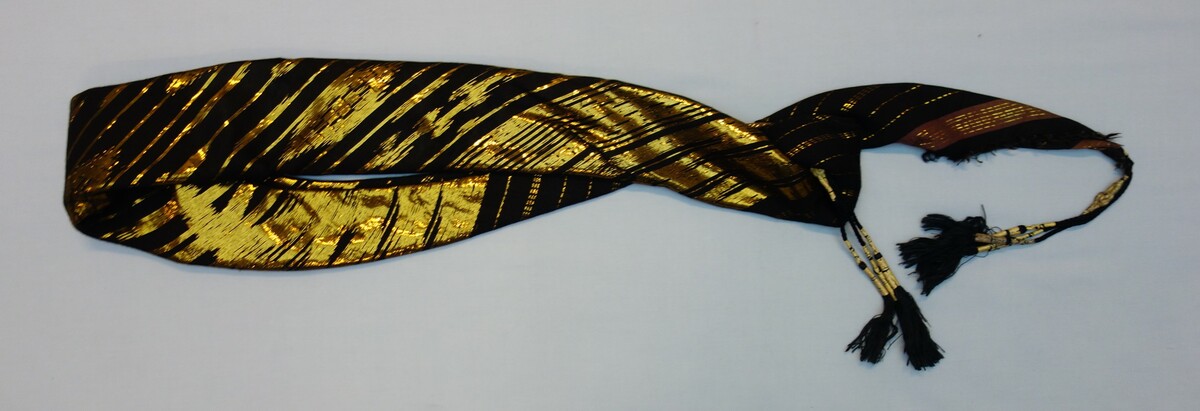 Headband (asba) from Jordan, 1970's (TRC 2005.0164).
The reasons for wearing such a long dress is little known, but there is a popular story that efers back to the Ottoman period, when women used to smuggle and hide valuable stuff from the tax collectors inside her dress.
Nowadays the use of the Khalaga dress has completely disappeared from women’s daily life. And yet, there is a long standing tradition for women of various ages to make their way to downtown Al Salt, to the photo studio and have a picture taken wearing a rented Khalaga dress. This photograph is then framed and displayed inside the house as a symbol of pride, vanity and belonging to this city.
Recently, I was very pleased to discover a small group of local women from Al Salt who decided to revive the use of the Khalaga dress in a renewed form. They made the dress smaller and more suitable for modern daily life. They maintained some basic elements, such as the blue bands and the long pointed sleeves, but also introduced a new embroidered motif to the dress.
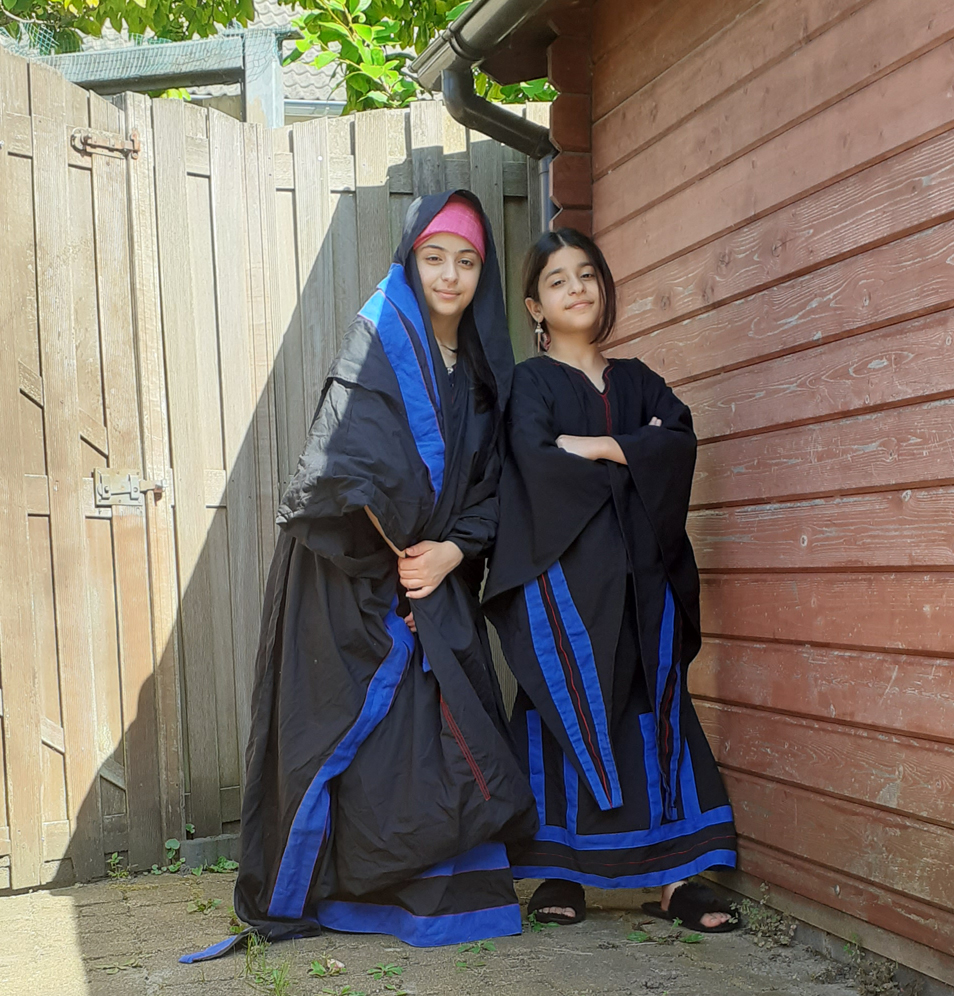 Two models in the Netherlands, wearing replica Al Salt khalaga dresses, made by the TRC. Photograph by Fatima Abbadi.
This modernization brought this forgotten dress back to life and nowadays you can easily spot women wearing it on special occasions, such as at graduation parties, weddings and religious celebrations.
The town of Al Salt has a special place in my heart. It was the hometown of my grandparents, my summer childhood memories belong there and whenever I talk about Al Salt, sweet memories come back to life. Hence this summer, during my embroidery workshop at Capelle A/D IJssel (The Netherlands), I decided to talk about the Khalaga dress and give a small demonstration on how to wear it.
The dressing up of the workshop ladies ended up to be a difficult task, wrapped up with infinite moments of laughter and joy. Trying to lift up the three meter dress and drape it down correctly was a complicated affair and the hot summer weather made it even more difficult. At the end we all wondered and asked ourselves how was it possible to wear such a heavy dress during the summer season? A question that I couldn’t give answer, an enigma that will remain hidden in the souls of the past and the ruins of history.
Fatima Abbadi, 25 October 2020.