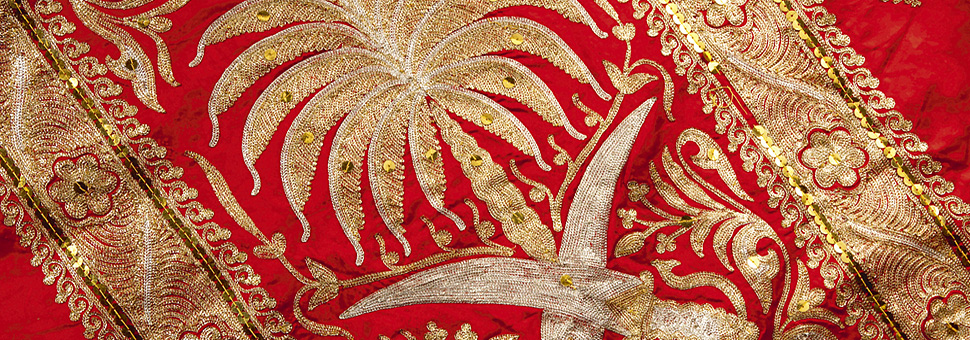
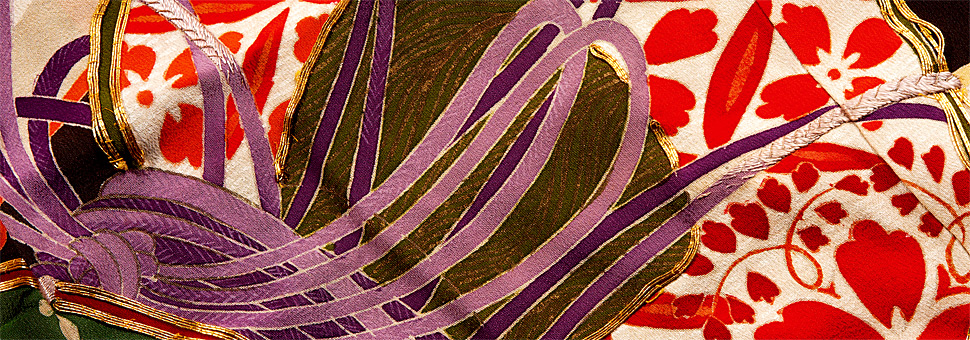
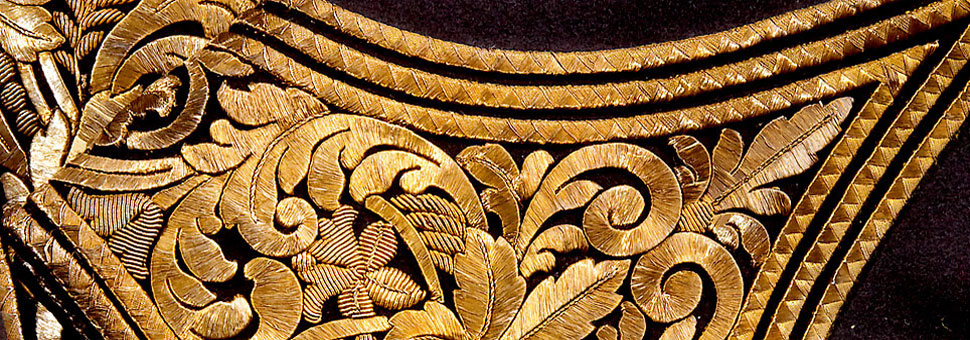

The TRC object of the month is a bridal outfit from India. It has been selected and described by Angeliki Karakonstanti (TRC intern from Leiden University). It can be admired at the TRC for the whole of May 2012. The outfit consists of a red skirt (lehenga) with matching blouse (choli) and shawl (chunni). The skirt (lehenga) is ankle length and very full. The blouse (choli) has short sleeves and decorative buttons down the front. Both the skirt and blouse are made from heavy silk and lined with cotton. The shawl consists of a large rectangle of a fine, red gauze. All of the garments are decorated with heavy, hand embroidered patterns of zardozi (a special form of Indian embroidery).
Zardozi is a form of hand embroidery that uses metal threads, wires, beads and pearls in order to create elaborate and rich motifs. Not surprisingly, zardozi is often used for ceremonial garments of various types, including bridal outfits.
This kind of wedding outfit is often worn in northern and western India, as well as parts of Pakistan. The garments are made from many different fabrics: cotton, silk, crape and satin.
In Western countries white is normally used for weddings, however in India white is not the preferred bridal colour, as it is traditionally used for funerals and mourning. Instead, red is often used, as it symbolizes the bride’s vitality and beauty. Sometimes the bride may be dressed in yellow, which is the colour of a young virgin, or green, the colour of growth and fecundity.
A wedding is one of the most important rituals in Indian culture and it often combines religious and local traditions. The wedding ceremony is divided into three parts:(a) the signing of the agreement between the two families, (b) the wedding ceremony itself, and (c) the bride’s procession to the groom’s house. Preparing the bride for her wedding day is a most serious matter. Before the wedding, the bride is given a ritual bath and her female family members and friends help her to get dressed. Her hands and feet are highlighted with make-up, and she is adorned with a wide variety of jewellery.
Traditionally, the bride changes her outfit at least twice. During the marriage ceremony, for example, she might wear the red outfit and then later change into clothes of another colour. This change signifies the transition of the bride from her natal family to that of her husband’s and indicates her new role as a married woman within society.
- Keywords: Clothing, gold embroidery, zardozi, wedding, India, Pakistan
- Object type: Bridal outfit
- Local name: Ghagra choli / Lehenga choli
- Country: India and Pakistan
- Date: 2002
- Materials: Cotton, silk, gold coloured thread, semi-precious stones, beads
- Techniques: Embroidery, woven
- Dimensions: Skirt: H 108 cm, W 142 cm. Waist 45 cm. Blouse: H 58 cm, W 136 cm. Waist 50. Shawl: H 238, W 119
- TRC number: 2002-0024a-c
Further reading:
Tarlo, Emma, Clothing Matters: Dress and Its Symbolism in Modern India, Chicago, University of Chicago Press, 1996.
(eds) Foster, Helen Bradley and Johnson, Donald Clay, Wedding Dress Across Cultures, Berg, Oxford, New York, 2003.
Nair P.T., Marriage and Dowry in India, Calcutta, Minerva Associates, 1978.
See also: