On the 10th April 2020, Gillian Vogelsang-Eastwood wrote a blog about a sampler that had recently been donated to the TRC Leiden. The sampler had been worked in 1872 by Jane Hardy when she was ten years old. She went to Burton Leonard School, in North Yorkshire, England.
More details about Jane Hardy have now been provided by Vivienne Rivis, a local historian, with the help of members of Burton Leonard History Group and the kind permission of Burton Leonard Primary School. The story and the sampler bring to life a girl from Yorkshire who died at a young age, and was long forgotten.
 School of Jane Hardy, as it presents itself nowadays along the High Green of Burton Leonard, Yorkshire.
"Jane Hardy was born on or about 29th March 1861, in Burton Leonard, then in the West Riding of Yorkshire. She was baptised at the parish church, then St Helen’s, on the 10th July of that year. Her father, Thomas, was a cordwainer or shoemaker, who was born in the village of Skelton, near York, in about 1812. Her mother, also called Jane, was born in Topcliffe, near Thirsk, in about 1825. Jane was their seventh child and was only aged 10 days at the time of 1861 census. Unusually, all the Hardy children were born in Burton Leonard, suggesting the couple settled there before or at the time of their marriage. Two younger children were born after Jane and the couple went on to raise Fred, the child of their eldest son, Edward.
We know nothing more at this time of Jane’s short life, other than that she died in the October quarter of 1880, aged 19. We will order her death certificate in order to find out more about what brought her life to an end at such an early age.
 St. Leonard's church at Burton Leonard. The church dates to 1878. Jane Hardy's funeral probably took place inside this church, in 1880.
The description below of the Hardy home and the Burton Leonard school (which is still thriving!) is intended to put Jane’s home and school life in context.
The Hardy home
We believe that the Hardy family lived in a house close to the Hare and Hounds, then one of the village’s three pubs, where their younger son, Thomas, later carried on his father’s trade. Then it would have been a cottage with enough space for a workshop inside or more probably in an outbuilding. It has now been renamed The Manor House and appears through repeated alterations to be a more substantial and genteel dwelling than it was during the Hardy family’s long occupation.
Burton Leonard was known in the early 19th century for its tannery and fine saddlery trade. Nearby Ripon was renowned for making rowels or spurs, an essential piece of horse tack. The Hardy family lived next door to the last saddler in the village, together forming the last vestiges of the leather industry in the village, as the tannery closed before 1900, remaining derelict until the 1980s.
 Children in front of the Burton Leonard school, c. 1900. Postcard.Burton Leonard School
Jane was born before the introduction of compulsory schooling in England and Wales (the 1880 Education Act), but, like her siblings, she attended the local school higher up the village on the south side of the high green. The school building and site were owned by its patron, James Brown, a Leeds industrialist who had bought the neighbouring estate of Copgrove.
The School was and is a denominational school of the Church of England, so its curriculum was in part prescribed, and its religious teaching monitored, by the diocese of Ripon. The school was built in early 1800s, probably at the instigation of the local landowning family, the Duncombes of Copgrove. Brown bought the estate from Duncombe’s heir and proceeded to rebuild the parish church, reverting to the old name of St Leonard’s, and to extend the tiny school. Jane may have left school just as the new school room was being completed in 1874, which must have provided many more school places for the children of the village’s workers.
 Burton Leonard school as depicted on an old postcard.
The school inspector recorded his approval in October 1874: “I am exceedingly glad to find the enlargement of the building carried out in such a handsome and satisfactory manner.”
We have found no record so far of Jane in the school logbooks that were handwritten by the headteacher, Charles Wilson, who would have taught both Jane and her siblings. Several of the Hardy children are mentioned, however, particularly her younger sister, Sophia, who was frequently absent for long periods. We do not know whether she was sickly, as many of the children in the village were, or simply helping her mother at home, which was also very common.
The headteacher struggled with many challenges when he took over the school in 1869. He found the children had been poorly taught, did not know their scriptures and attendance was often very poor. Not only did the children stay away for feasts, hiring fairs and holidays, they were required to form part of the agricultural seasonal labour force, with tasks ranging from bird-scaring, cowslip picking, hay-making, harvesting, blackberry and potato picking. Girls were kept at home to look after younger siblings or help with cleaning.
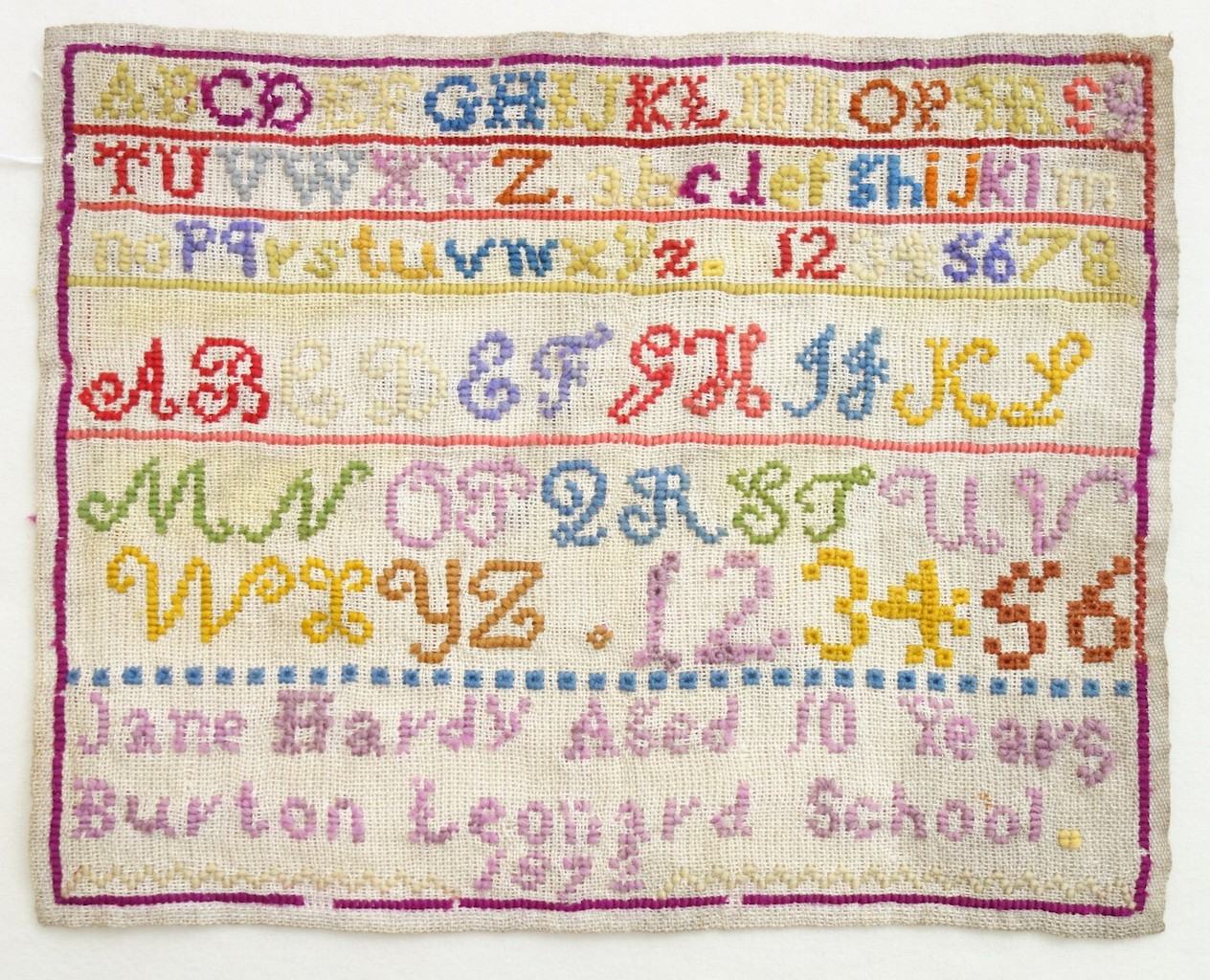 Jane Hardy's sampler, worked in 1872 when she was ten years old (TRC 2020.1606).Sewing and Burton Leonard School
Sewing was seen as an important part of the children's education, although Charles Wilson, the father of four daughters who all became teachers, commented rather bitterly in September 1869: “It would be of advantage to the girls to have one lesson with me in the afternoon instead of spending three hours in sewing.” We think the sewing lessons were undertaken by his wife, Jane Ann Wilson, who seems to have taught the infants in the overcrowded school whilst also looking after her own growing family.
On Friday 22 March 1870, “Miss Shiffner brought sewing for all the little girls”. Miss Shiffner was probably Emily, or her sister, who were the nieces of the unmarried school patron, James Brown. Emily Shiffner inherited the Copgrove estate with its patronage of the School from her uncle, and as Lady Bridgeman continued his benevolence towards its pupils until her death in 1927. It seems very likely that the materials for Jane’s sampler, with its bright colours, were provided by Miss Shiffner.
At the next inspection in May 1870 this paid off: “The master and his wife deserve great praise for the work they have done in the school… The needlework is very good indeed.” A change was made in December 1870: “The girls go to their sewing on the first instead of the last part of the afternoon.”
In January 1871, “Thos & Sophia Hardy return to school” suggesting a significant absence. The following week “I find Sophia Hardy and James Geldart have forgotten nearly everything they learnt” suggesting that education was not a high priority in the hardworking Hardy household.
At the annual inspection in May 1871 “The sewing is also good” so Jane‘s sampler, dated 1872, was made when sewing was a key part of the curriculum for girls. However, by the latest date that Jane would have left the school, in October 1875: “The greatest difficulty is with the sewing classes, the parents being determined to send their own work to school. They keep their children knitting for weeks together so no progress can be made with sewing.”
As the 1870s economic downturn and foreign food imports hit British agricultural communities hard, it is no wonder that mothers tried to get the family mending and sewing done by their daughters during school hours. It seems likely Jane in fact left before she was 14.
There were also much more serious challenges to be faced, which now have a strange resonance with our own times. The cramped conditions of the school and the poverty many families must have experienced meant that children were frequently ill with childhood diseases which then could be lethal. In January 1874: “Many have stayed away on account of the fear of infection from scarlet fever...Scarlet fever and bronchitis is continuing to spread in the village.”
Did Jane die of one of these diseases or perhaps another common illness, tuberculosis? As soon as we have more details, we will let you know."
16 April 2020, by Vivienne Rivis in Burton Leonard, This email address is being protected from spambots. You need JavaScript enabled to view it.


 First Lady Mary Todd Lincoln’s dress, made by Elizabeth Keckley.Sewing has meant many things, from drudgery to inspiration, to many people. For one 19th century woman, it meant freedom. Elizabeth Keckley (1818-1907) was born enslaved on a plantation in Virginia (USA). When she was four years old, her mother taught her to sew. At 14 she was sent to work in another state, where she was repeatedly beaten and whipped for her “stubborn pride”.