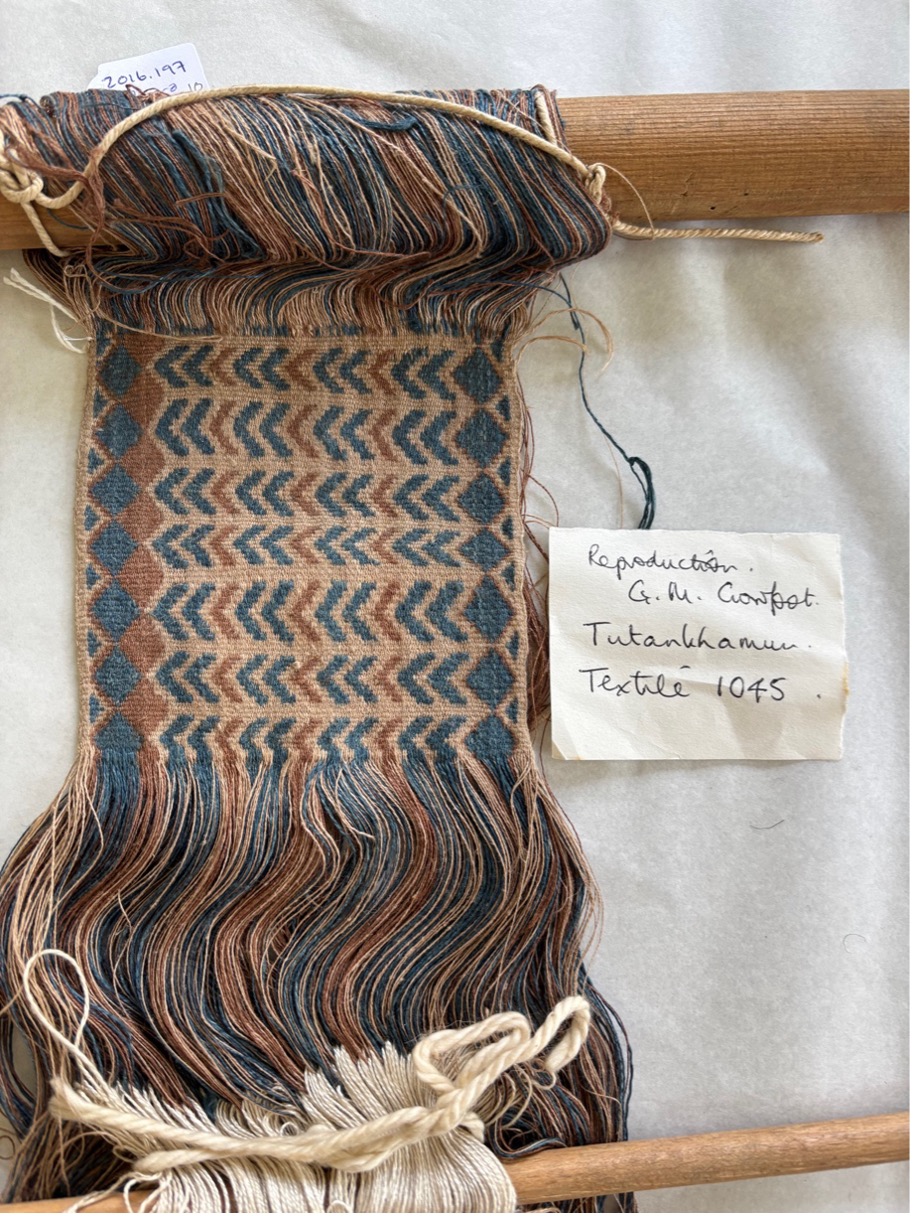
 Fig. 1. Recreation by Grace Crowfoot of one of the textiles found in the tomb of the Egyptian pharaoh, Tutankhamun (TRC 2016.0197).(Jo Andrews, 19 July 2026) For someone who understands the world through textiles, opening a box at the TRC in Leiden is the best of surprises. You’re never quite sure what you are going to find. There is so much to explore, so much treasure on the shelves of this extraordinary storehouse it is hard to know where to begin. And even if you start with a clear objective in mind, just climbing the stairs past boxes labelled ‘cloth indigo’, ‘feedsacks’ or ‘Female outfits: mourning Friesland’ makes the fingers start to itch. But focus is the name of the game here.
I came to look at the collection of Grace Crowfoot, a woman who has been called the mother of textile archaeology. TRC holds an important collection of her weaving and spinning artefacts. If you want to understand Grace, this is where you need to start. These boxes tell you a great deal more than words and pictures: they are a window into how she thought, and they give you an insight into the enormous variety of projects she undertook and the immense skill she brought to them.
Grace was born in 1877 in Lincolnshire to an intelligent, talented and well-off family. She was surrounded by people interested in archaeology from her earliest days, but it was a trip to the West Highlands of Scotland as a young woman where she saw wool being spun on a great wheel, that first sparked her interest in textiles.
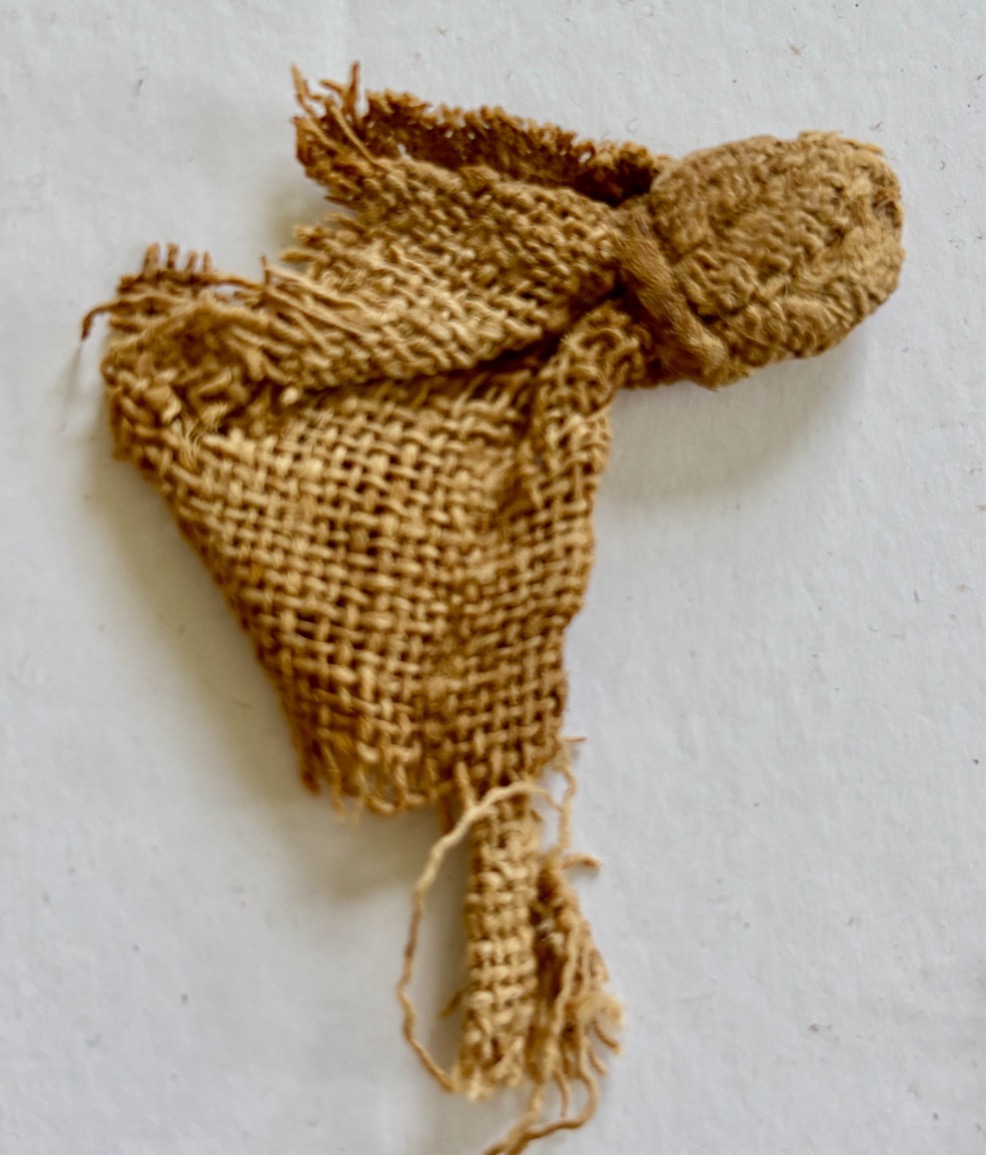 Fig. 2. Button from the Qumran Cave text (TRC 2019.2427).Grace married in 1909 and moved with her husband, John Winter Crowfoot, to Egypt and later Sudan, where he was to become Director of Gordon College in Khartoum. It was here that Grace learnt from local women how to spin cotton and use their ancient ground-looms, knowledge that was so important for her published studies of the paintings and models of weaving from the Pharaonic Tombs of Egypt.
She studied tablet weaving and understood exactly how the braids and girdles that accompanied many of the spectacular Egyptian textile finds were made. Was this double weave, tablet woven or produced on a primitive loom with rigid heddles? Grace Crowfoot could identify the precise weave and then she could reproduce it on a loom she made herself.
TRC’s boxes bear witness to all of this in a way that letters and photographs could never do. One box has a collection of simple spindles from Egypt and Sudan – some of them look just like sticks that you might pick up from the ground – often used with a weight made from a disc of dried gourd on the end. There are tablets made of camel leather. In one box there are a pair of large clean bones, marked “Camel Rib Beaters” and, yes, if you study the edges carefully you can see where the warps have bitten into the bones.
You can feel Grace Crowfoot’s inquiring mind as you open boxes of beautifully woven and brightly coloured camel girths from Egypt, Sudan and Turkey, handwoven ikat from Syria, a tiny braided woollen slingshot made in the 1920s or 30s in Syria – something that had been in use since Biblical times: there are Nigerian and Congolese fabrics, cloth from an Egyptian mummy and numerous braids, mainly woven by Grace Crowfoot herself.
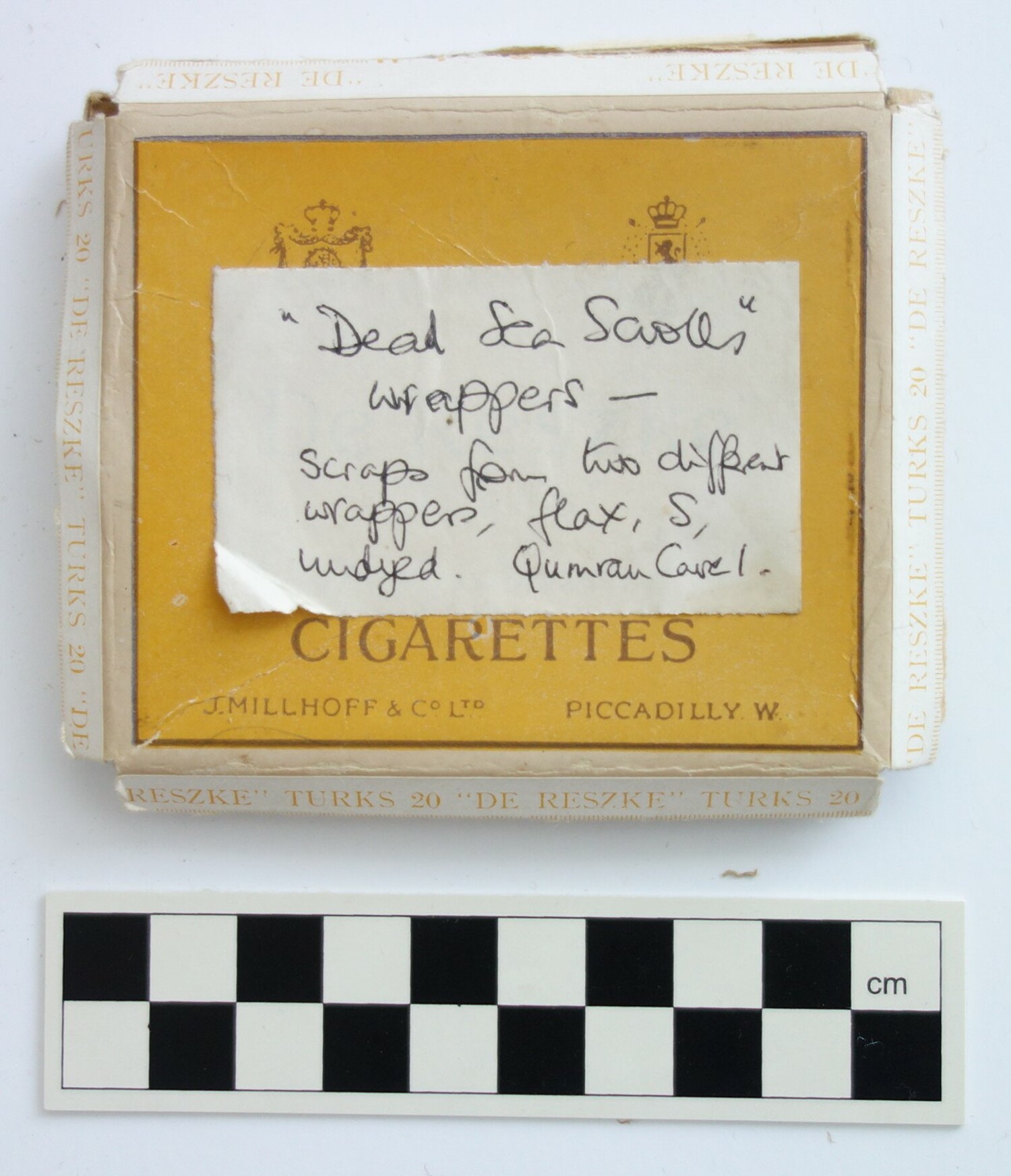 Fig. 3. Cigarette box with textile fragments from Qumran, Westbank (TRC 2019.2410). The writing on the card is by Elisabeth Crowfoot, a daughter of Grace Crowfoot.Above all there are many looms. These are Grace Crowfoot’s trial looms, and they are made of anything and everything. I love my own weaving loom – it’s Canadian Maplewood and an expensive piece of kit. The looms here are made of whatever was to hand: crayons, knitting needles, bits of old string, garden bamboo, even, in one case, the cardboard interior of a kitchen roll. These are simple, Egyptian style, looms with rod heddles. This is where she thought her way through the structure and concept of ancient textiles and worked out how to recreate them. There is the loom on which she remade the famous warp faced double weave Ramses III girdle, a textile from Tutankhamen’s tomb (Fig. 1), the edging from the Tarkhan dress in the Petrie Museum in London and more.
Grace and her husband John moved from Egypt to Palestine in 1926, where he became Director of the British School of Archaeology in Jerusalem. You can track her travels through the boxes, not least through the old trunk labels she sometimes used to catalogue her artefacts. One of these reads: “Bedouin Sword Beater – from the outskirts of Alexandria” The rest of the label says ‘Crowfoot – London (crossed out) Jerusalem (crossed out) London via P&O Rajaputana (crossed out) and then finally their home address in Norfolk (not crossed out!). It was a life lived against a colonial background that a 100 years later has disappeared utterly, just as the techniques and textiles she saw created in homes and workshops across the region have vanished.
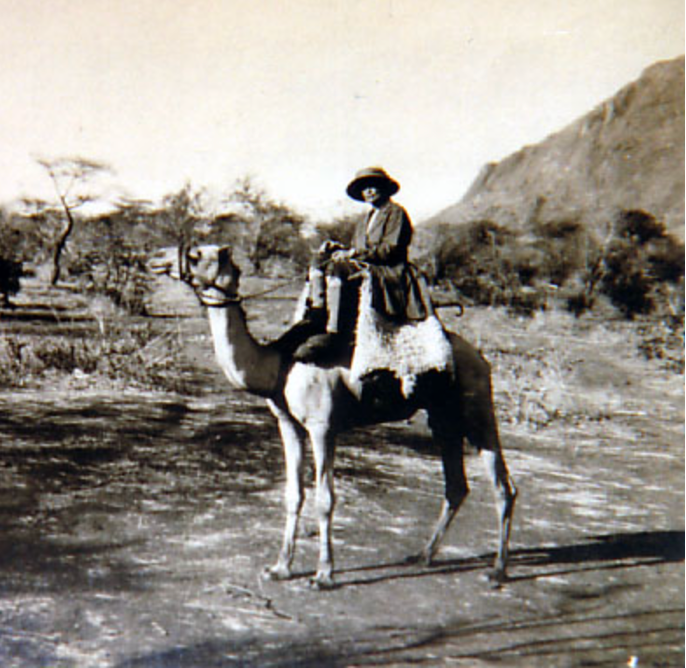 FIg. 4. Grace Crowfoot in Nubia, date unknown.The Crowfoots came back to Britain in the late 1930s, but the work did not stop. Grace analysed the relics of St Cuthbert at Durham Cathedral. She studied the diverse tabby and twill wool weaves found in the Sutton Hoo Anglo Saxon burial ship and there is a snippet of the 7th century wool blanket from the Lancaster Canoe burial. But my favourite find was a tiny cigarette box and its contents. In around 1950 the textiles from the Qumran Cave arrived in Britain to be analysed. These were the textiles that had wrapped and covered the Dead Sea Scrolls that were discovered in Cave 1.
Grace Crowfoot wrote the first definitive paper on these extraordinary two thousand-year-old linen textiles. Most of the important ones then went back to museums on the West Bank and in Jordan. But the tiny pieces that were too small to be of interest to the museums went to Mrs Crowfoot (Fig. 2). It seems these were the tiny wedges used to prop the scrolls in place and stop them falling against each other. She packed them carefully in a cigarette box and there they sat for several years until her daughter gave them to Gillian Vogelsang Eastwood – the founding Director of TRC (Fig. 3).
It is magical to see them, they are all used clothes and would have been old when they were repurposed as packing material. They are linen and woven in many different qualities. There is a nicely rolled seam, the remains of a tasselled edge and part of a linen button that would have fastened an over shirt. More than anything it is these tiny scraps that bring the past alive and allow the people of the time to become real, breathing human beings, people who sewed a seam and were in need of buttons, just like us.
For the collection of Grace Crowfoot now in the TRC collection, open the TRC online catalogue and type in: Grace Crowfoot. For another blog about Grace Crowfoot and her collection now at the TRC, see a brief introduction by Gillian Vogelsang-Eastwood. There is another blog, written by Gillian Vogelsang-Eastwood (2018), about some specific correspondence by Grace Crowfoot, and by Alice Jaspers, written in 2019.