Textile Tales From The Second World War
0. Cover page
This year marks the 75th anniversary of the end of the Second World War (1939-1945), an event that still reverberates in the lives of people in The Netherlands, Europe and indeed in many other parts of the world.
The collection of the TRC in Leiden houses various textiles, garments and accessories, which reflect life in the Netherlands during the Second World War and shortly afterwards. They all tell a story. Some of these are simple, others are painful, but they reflect the different ways that textiles, garments and accessories were made and used. And in many cases they still retain personal and family stories associated with them. This online exhibition looks at some of these stories and puts them in the context of those disturbing times.
 Preparing the TRC exhibition 'Textiles Tales from the Second World War', Sept. 2020 - Jan. 2021.
This online display is based on an onsite exhibition that was organised and set up by the Textile Research Centre in Leiden in the second half of 2020.
Please click on the illustrations below to go to the various sections.
Colophon:
- Authors: Marieke Roozeboom and Gillian Vogelsang-Eastwood
- Web-design: Joost Koopman
- Exhibition design and text editor: Willem Vogelsang
- Publisher: TRC Leiden.
- Year of publication: 2020
- Copyright: All illustrations of objects housed in the TRC collection can be used free of charge, but please add to the caption: "Courtesy Textile Research Centre, Leiden" and the accession number (for instance: TRC 2020.3000).
12. Mennonite relief comforters
The Doopsgezinden, also known as the Mennonites, are a Christian Anabaptist community that can be found in many parts of the world. The community dates back to the sixteenth century, when a Dutch Roman Catholic priest called Menno Simons (1496-1561) converted to Anabaptism (a form of Protestantism that promotes the baptism of adults) and became the namesake of a movement known as the Mennonites.
A feature of Mennonite way of life is helping those in need. Throughout the nineteenth and twentieth centuries the Mennonites have been producing quilts, especially for those in distress. These relief quilts (often called comforters) are especially associated with Mennonite groups in the USA and Canada. Following the end of the Second World War in 1945, hundreds of relief quilts were sent from North America to Europe, including the Netherlands and Germany. A selection of these quilts was on display at the TRC exhibition. These include a group of 'comforters' (two-layer quilts) that were organised by the Canadian Red Cross and transported to Europe, many of which ended up in a disused railway carriage in Austria (for this remarkable story, see the TRC blog of 25 September 2020). For more information, click here.
 Passing on the Comfort: the War, The Quilts and the Women who made the Difference, by An Keuning-Tichelaar and Lynn Kaplanian-Buller. 2005. Click on the illustration for more information.An and Herman Keuning and relief quilts
Just after the end of the war, a group of Mennonites who had fled from the Ukraine were offered refuge in the Netherlands before traveling on to Paraguay. They were helped by a Mennonite pastoral couple named An and Herman Keuning. They lived in Irnsum, Friesland, in the north of the country. Despite acute shortages in the Netherlands, they organised guest homes for 100 people in and around Irnsum.
A shortage of bedding prompted An to contact the Mennonite Central Committee (MCC) office in Amsterdam and as a result hundreds of quilts made by Mennonites in North America that were sent to Amsterdam as relief goods, were soon delivered in Irnsum.
Many of these quilts remained in the Netherlands after the Ukraine Mennonite refugees had emigrated to Paraguay. They were preserved by An Keuning. In 2004 the MCC was informed about the quilts and since then theq uilts have been on tour to various parts of the world, including North America, Ukraine, Germany and France. The story of these quilts is also told in: Passing on the Comfort: the War, the Quilts and the Women who made a Difference, by Lynn Kaplanian-Buller and An Keuning-Tichelaar (2005).
 Mennonite relief quilts being distributed in the Netherlands, 1946 (Mennonite Central Committee).
Modern relief quilts
For some years, European Mennonites in the Netherlands, France, Germany and Switzerland have formed sewing groups to make quilts for Syrian and other refugees in Jordan and on the Greek island of Lesbos. These are being distributed by the MCC in the Middle East.
See also: 'Passing on the Comfort to the TRC', a TRC blog by Lynn Kaplanian-Buller, 29 January 2020, and 'I lost a quilt given to my care…. and that‘s all right,' another TRC blog by the same author, 23 September 2020.
11. The years after the war
The first few years following the liberation of the country in 1944/1945 are characterised by a rebuilding and general feeling among the Dutch of the re-emergence of the Netherlands.
The defeat of Nazi Germany, the succession to the throne by Queen Juliana in 1948, and the Dutch recognition of Indonesian independence in 1949 marked for many Dutch people the start of a new beginning.
The postwar period was also the time that Nazi Germans and their Dutch sympathisers were arrested, charged and sentenced by Dutch courts. Some of the germans and their Dutch collaborators were executed; many were imprisoned. Immediately after the war ended, some 100,000 Dutch people were interned.
One of these internment camps was in Stadskanaal, in the north of the country. The TRC houses a most intriguing memento of the Stadskanaal prisoners, namely a handkerchief embroidered with the names of many of the women held there (TRC 2015.0193).
The Feestrok
The Feestrok is a patchwork skirt that was made by many Dutch women after the war to celebrate the liberation of the country. The idea was born in 1943, when Mies Boissevain-Van Lennep (1896-1965), who had joined the resistance against the Germans during the war, was imprisoned by the occupying forces. While in prison she was sent a scarf tie that was made from scraps of cloth from the clothes of family and friends.
After the liberation, she became a member of a women's committee that wanted to create a garment that reflected the diversity, unity and reconstruction of the Netherlands after the war. The Feestrok symbolised 'unity from diversity'; 'new out of old'; 'building up from ruins'. Anyone who made a Feestrok skirt could have it officially registered. In the end, 4,000 of these skirts were registered, but many more were made and worn. The TRC Collection houses a number of these garments, and one of them is illustrated here (TRC 2011.0001a).
 Tablecloth produced by the Ferwerda company in 1945/1946, to celebrate the liberation of the Netherlands (TRC 2014.0814). For more information, click on the illustration.National breakfast tablecloth
In 1945/46, the Ferwerda company sold a tablecloth commemorating the liberation of the Netherlands (compare TRC 2014.0814). In the centre is the Dutch lion rampant with a sword piercing a swastika. This tablecloth was designed during the war, the first 144 copies were woven clandestinely from artificial silk that was actually intended for towels to be sent to Germany.
Parachute fabric
After the liberation, parachute fabric was used to make clothing. Initially, parachutes were made from long pieces of silk. During the war, nylon, a synthetic material that had been introduced by Dupont in 1935, was further developed and used for parachutes.
 Christening gown made of parachute silk, 1947 (TRC 2017.3365). For more information, click on the illustration.Most of the parachute fabric used to make clothing was acquired soon after the liberation. Some came from parachutes that were used before, during the occupation, and had been kept for years. Given the shortage of textiles, the fabric was more than welcome and the clothing made from it added extra lustre to the liberation and the years that followed. Many wedding and christening dresses were made from parachute fabric.
One of these christening gowns, now in he TRC collection (TRC 2017.33657.3365) was made in 1947 from material acquired during the war, and was subsequently used for the christening of seventeen children between 1947 and 2013. For a TRC blog on the subject, see Christening gown with a rich history (1 November 2017).
New Look
In February 1947, Christian Dior released a new collection, characterised by long, full skirts with petticoats, a wasp waist and shoulders without padding. After the long period of thrift and austerity, this feminine and luxurious style matched the post-war mood.
The editor-in-chief of Harper's Bazaar called Dior's dresses "such a new look," which is how this style received its name. Not everyone was happy with the New Look. In the USA, women demonstrated against this style, which for them symbolised the surrender of their freedoms: no longer working in the factory, but back to the kitchen and into a corset. That did not stop the success: the New Look became the post-war clothing style.
 Handkerchief with the embroidered names of Dutch women who were interned after the war at Stadskanaal, Groningen (TRC 2015.0193). For more information, click on the illustration.
For the Kerchief from Stadskanaal, see the TRC blogs:
- The Stadskanaal embroidered kerchief, part 4, 5 September 2015
- The Stadskanaal embroidered kerchief, part 3, 14 April 2015
- Stadskanaal kerchief, continued, 12 April 2015
- Commemorative kerchief from Stadskanaal, May 1945, 4 April 2015
For the Feestrok, see the TRC blogs:
- An unexpected donation of a Feestrok, 17 September 2020
- The Feestrok revisited, by an American student, 9 January 2019
- The Feestrok, again, 18 November 2018
- The Dutch 'Feestrok', celebrating liberation from Nazi Germany, August 2018
- Festival skirt: A colourful reaction to the horrors of the Second World War, January 2011
For the 'New Look", see the TRC blog
- The post-war 'New Look', 12 October 2020.
10. The liberation
The period immediately after the liberation was a festive and special time for many people, although the scarcity and poverty continued. But there was another side: apart from civilians and military killed in the war, more than 100,000 Dutch Jewish people did not return from the extermination camps in Nazi Germany.
Liberation parties
At the liberation celebrations, during which the Allies were festively welcomed, many people wore clothes in red-white-blue or orange, recalling the colours of the national Dutch flag. Many people obviously had kept hidden some textiles in those colours. Pins and other jewellery in the same colours were worn and children were being dressed up in festive garments. At one of these parties, in Leiden, a little girl wore a Volendam-style outfit, which is now housed in the TRC collection. The little girl wearing the outfit visited the TRC and was photographed together with her Volendam outfit (see the TRC blog A fancy-dress outfit for a little girl from May 1945: reunited (Gillian Vogelsang, 7 September 2020).
Sweetheart souvenirs
Most of the soldiers who liberated the Netherlands and the rest of Europe came from America and Canada and were often away from home for a long time. Many soldiers therefore made or bought sweetheart souvenirs, such as scarves or jewellery, for their loved ones at home. Army units also produced their own sweetheart mementoes for their men, such as the R.E.M.E. scarf in this exhibition (TRC 2020.3715)
 Pair of miniature Dutch wooden clogs, probably bought as a souvenir by a British soldier and sent home as a souvenir. (TRC 2020.3020a-b). For more information, click on the illustration.Liberation clogs
Many Dutch people gave home-made souvenirs to Allied soldiers to commemorate the liberation, such as painted clogs. These could be real clogs or miniature versions. Often it was engraved with the date "1945".
Coin jewellery
Between 1943 and 1945, the Dutch government in exile ordered large quantities of silver coins with the image of Queen Wilhelmina to be minted in the USA. On the coins, a letter below the year indicates where the coin was struck, D stands for Denver, P for Philadelphia and S for San Francisco. The coins were sent to the Netherlands after the liberation. Just as during the war, many people made coin jewellery from these coins to express their orange spirit.
For silver jewellery, see also the TRC blog, 'Dutch jewellery with silver coins from the Second World War', by Gillian Vogelsang, 20 September 2020.
9. Towards the end
While the southern part of the Netherlands was liberated in the autumn of 1944, the rest of the country passed through a period of severe austerity in the ensuing winter. The ‘Hongerwinter’ of 1944-1945 would for long remain prominent in the memory of the Dutch people. Relief only came in late April 1945, when Operation Chowhound and Operation Manna included airdrops of food supplies over the western parts of the Netherlands. The 'Zweeds wittebrood' ('Swedish white bread') became a symbol of liberation for a generation of Dutch people.
Textile confiscation
Between October and December 1944, the German occupying forces demanded clothing and textiles from the Dutch citizens for the support of the German troops. Since this went against international war regulations, the Dutch government from London instructed the remaining Dutch authorities not to cooperate.
The Germans then tried to pressure the citizens to "voluntarily" hand over goods. They threatened to punish them, or forbade people to walk outside when searches for textiles were carried out, so that textiles could not be hidden. Resistance newspapers warned against this "textile robbery" and advised people to hide their clothes and textiles.
Looting
The German occupiers plundered systematically, for example Jewish property, but at the end of the war, individual soldiers also stole goods. The damask napkin in the exhibition (TRC 2011.0122), with the crowned letter W representing Queen Wilhelmina, was stolen from Paleis ‘t Loo by a German soldier. Later the napkin was "liberated" by a Dutch family.
National Aid Action Red Cross (H.A.R.K.)
The liberation of the Netherlands started in September 1944 in Limburg. In the following months, parts of the provinces of Limburg, Noord-Brabant and Gelderland were liberated. It soon became apparent how destitute the Dutch population had become. There was a great need for household textiles in particular, but there was also a shortage of clothing: many people only had the clothes they were wearing at the time. The Allies brought in relief supplies - for the most part clothing, textiles and shoes - from the USA, the UK and Canada to alleviate the first needs.
An efficient and effective distribution of the foreign goods was necessary. Because of the international fame of the Red Cross, the name Nationale Hulp Actie Roode Kruis (‘National Aid Action Red Cross’) was chosen, although the aid campaign was not officially part of the Red Cross. In January 1945 the H.A.R.K. was established, with the task of alleviating the material needs of the war victims.
The H.A.R.K. was active until 1947. Most of the H.A.R.K. goods came from the USA, some 11½ million units. In total, the H.A.R.K. distributed nearly 18 million goods, both new and used, among war victims in the Netherlands.
8. Making something from nothing
"Take care of what you have" is the title of a brochure issued by the Dutch authorities of German occupied Holland in 1942. It was also the adage of the housewife. As the war progressed and scarcity increased, in spite of the rationing, there was little to be bought with the rationing coupons.
People had to make do with what they had. In women's magazines and in the few books published during the war about textiles and clothing, everything revolves around being economical with what people had, taking good care of it, washing and storing it, and repairing it as quickly as possible if it needed mending.
Repairing and improvising
Clothing was mended, dyed and changed over and over again. Socks were endlessly darned. Sweaters and bedspreads were unravelled and new garments were knitted from the wool. They also spun threads at home with illegally obtained materials, often plucked wool that was left behind on barbed wire. In addition, all kinds of other materials were used to make clothing, such as rope, carpet, curtains, flour bags or dog hair.
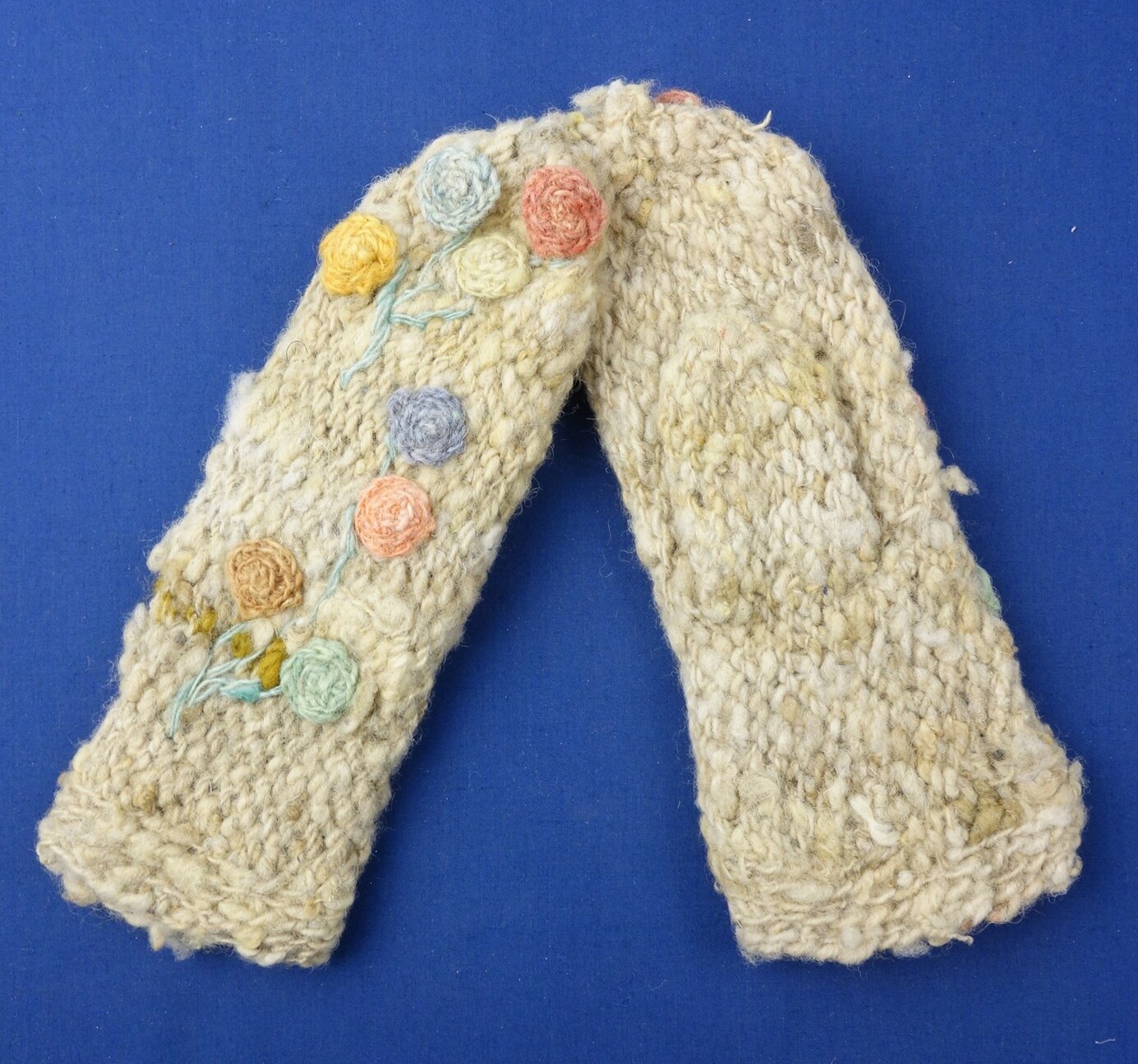 Hand knitted gloves, the Netherlands, 1940's (TRC 2016.2335a-b). For more information, click on the illustration.Fashion
At the end of the war, there were hardly any items of clothing seen in the streets that were made from one piece of cloth: clothing made from several older patches had become commonplace. Because almost everyone wore this type of clothing, this gradually became fashionable.
More with less
Those who made their own clothes often used a "false back" for blouses: a back made of a different type of cloth such as net. This could not be seen under a jacket. Some people wore blouses that consisted only of a front.
Swapping and trading
Much was exchanged among friends and acquaintances, and fairs were organised by churches, aid organisations and private individuals. Outfits were also shared. An example of this is the story of three friends who together owned a reasonably looking suit. One friend had the jacket, another the vest, the third the trousers.
Bridal dresses
During the war normal life continued, as much as possible. Tthere were weddings, and the bride still preferred to wear white, but then often in a dress that could later be dyed, altered and shortened to wear it again. One such dress is in the TRC collection (TRC 2019.2154), and was worn by a bride in Leiden on 20 April 1938 and again, dyed purple, she wore the same dress at her brother's wedding on 22 December 1943 (see also the TRC blog 'A Leiden wedding dress and WW II', by Gillian Vogelsang, 26 September 2019).
7. The distribution system
The occupying forces continued the distribution system that the Dutch government had introduced in 1939. In 1940, clothing was rationed. That the Dutch people were not very enthusiastic about the distribution system is shown by the fact that the Germans felt the need to publish the propaganda brochure "In uw belang" ('to your advantage'), which explained the necessity of the distribution and rationing system.
The textile card
In August 1940, every Dutch person was given a textile card with coupons for 100 points for a period of six months. Naturally, the goods also had to be paid for. The textile cards were provided with name, address and date of birth. There were separate cards for men, women, boys and girls. In 1941 and 1942 three more textile cards followed. The retailer cut the necessary points from the card and handed them in at the distribution office to obtain new stock. More and more points had to be handed in for each product and cards had to be used for longer and longer periods of time.
Soap coupons
Soap was also rationed, which made it extra important to use clothing and textiles carefully and sparingly. They were washed as little as possible. Anyone who brought washing to a central laundry had to hand in one of their soap coupons for a certain amount of washing. Vouchers for later use were issued if not all the soap was needed.
Shoes
Even earlier than textiles, shoes became part of the distribution system: in May 1940, a general ban was introduced on the free sale of shoes. To buy shoes, you had to have a shoe coupon, and for this purpose an extensive form had to be filled in, showing that the shoes were really required. As more of the leather went to the Germans, producers switched to making shoes from other materials. Shoes with wooden soles were widely worn.
Distribution after the war
The distribution system continued after the war. In March 1946 the first post-war textile card was issued, but no longer provided with name and address details. In 1947, 1948 and 1949 new textile cards followed, which were no longer differentiated by gender and age.
6. Silent resistance
During the German occupation of the Netherlands, all kinds of ways were devised to express resistance to the Germans and support for Queen Wilhelmina and the Dutch government in London.
Certainly at the beginning of the war, when there was still no question of organised resistance, this was often shown in a more or less playful way. These acts became known as "silent resistance." Often these forms of defiance were banned and forbidden by the occupying forces, after which something new was devised.
Coin jewellery
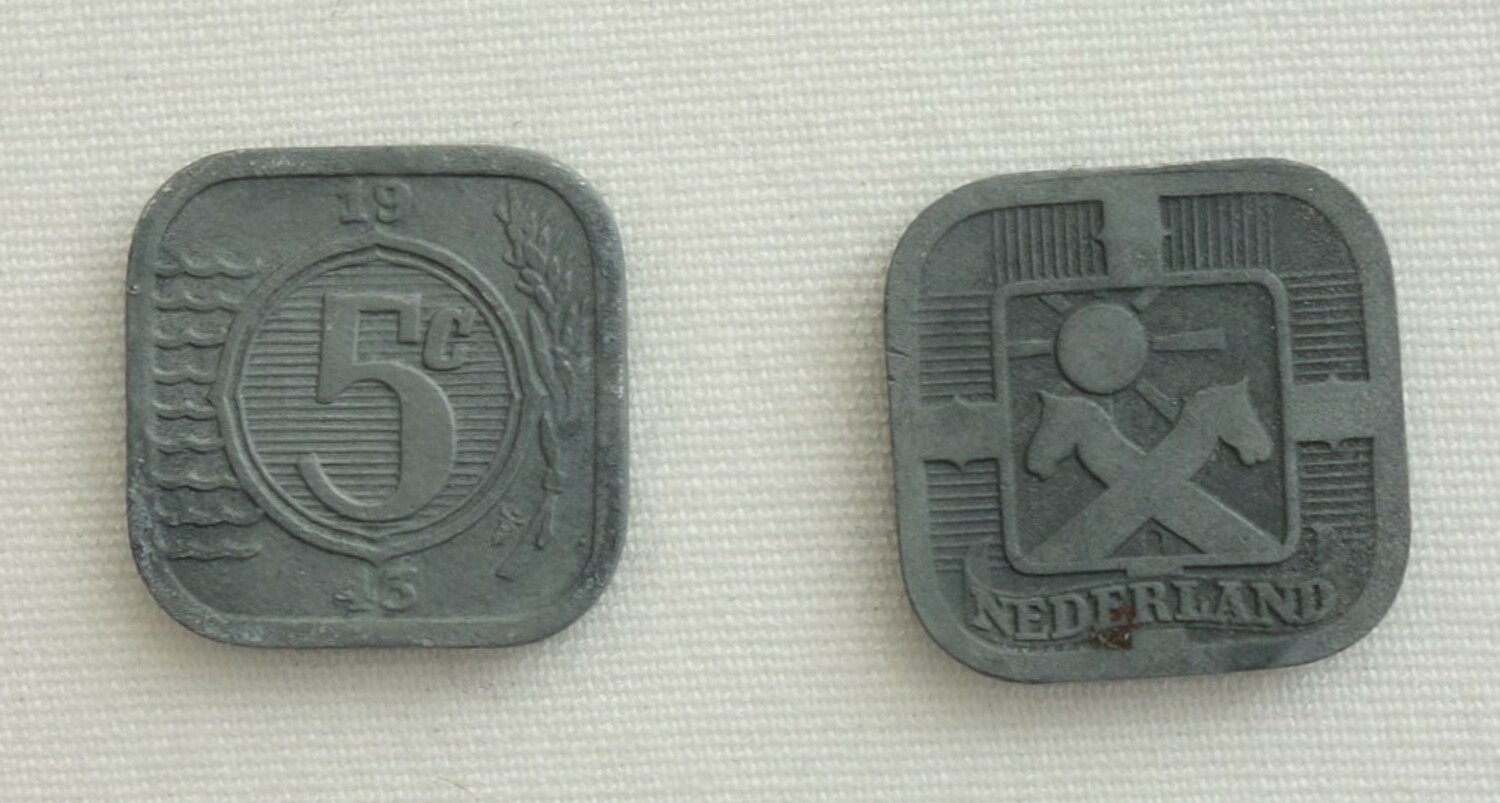
In 1941 the Germans seized all the silver and copper coins. This was on the one hand because the old coins bore the image of Queen Wilhelmina, on the other hand the metal was used for the German arms industry. The people had to hand in their old coins in exchange for new zinc coins or paper money. However, many Dutch people kept their old coins and turned them into jewellery, which was worn as a symbol of resistance and as a reminder of the royal family.
The V-sign
In 1941 the Dutch section of the BBC called for the V for Victory to be used, by making a V symbol with the fingers, or by wearing a pin with a V. A month later the National Socialists in the Netherlands hijacked the V, and posters appeared everywhere with the text: 'V = victory, because Germany wins for Europe on all fronts'. Since then, the V-sign was used by both sides.
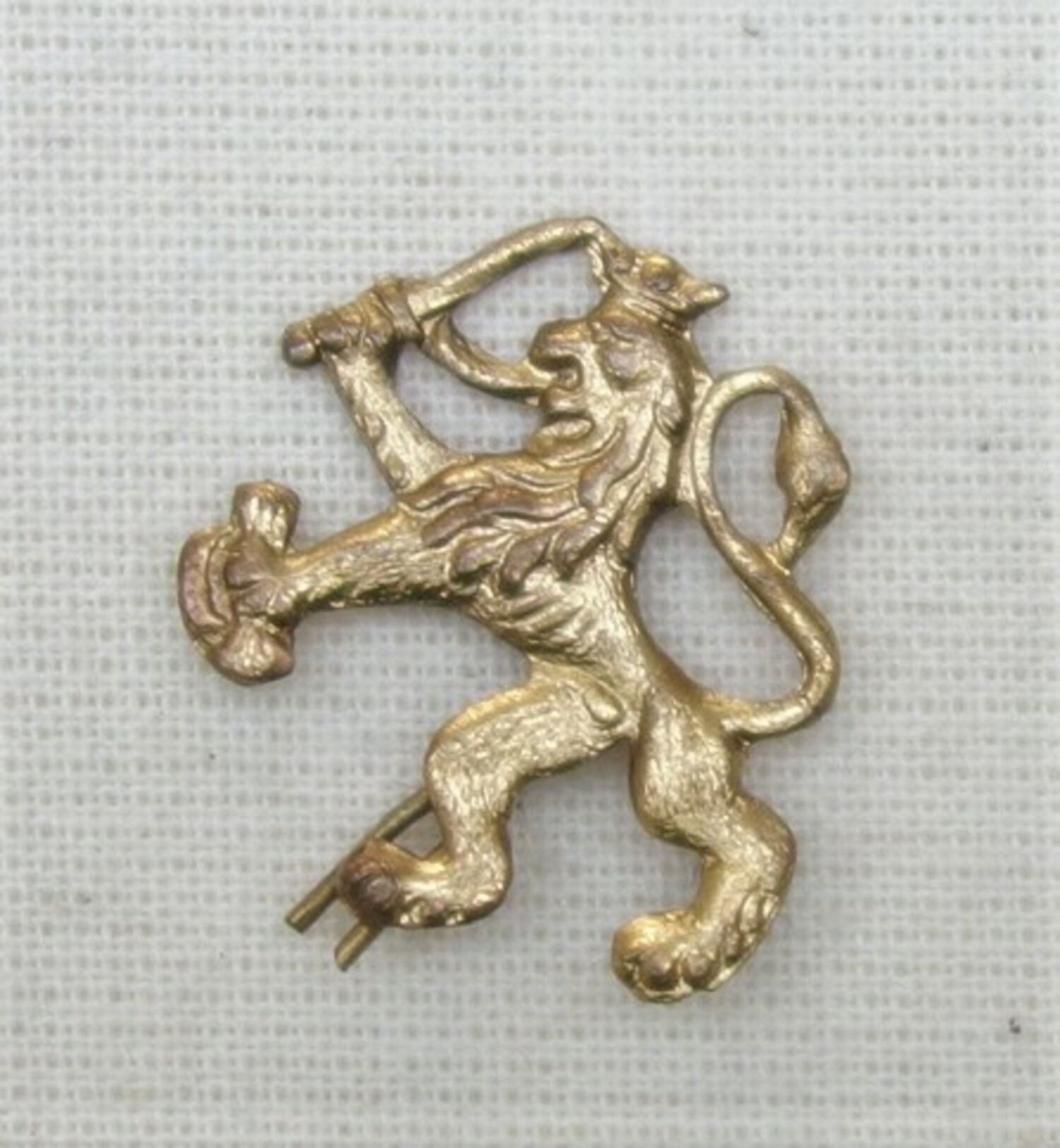 A small, metal 'Dutch' lion with sword and arrows, 1940's (TRC 2020.3726). For more information, click on illustration.The Dutch lion
The Dutch heraldic lion (a "climbing" rampant lion, holding a sword in one paw and arrows in the other) was also used by both sides: it could be found on resistance pins, but also on the uniform of the Weerbaarheids ('Defence') section of the National Socialists.
The Dutch flag
The Dutch flag was never officially banned during the occupation. It remained the national flag, but its use was strongly discouraged by the Germans. On royal birthdays, wearing red, white and blue clothes or hanging red, white and blue laundry was regarded as an act of defiance.
Matches
Another symbolic form of resistance was the carrying of a match in a buttonhole, with the (orange-yellow) head up, to which different meanings were given: "head up", "orange up", "burning with hatred".
For silver jewellery, see the TRC blog, 'Dutch jewellery with silver coins from the Second World War', by Gillian Vogelsang, 20 September 2020.
5. The Jewish Community
As early as 1940, the German occupying forces introduced an administrative division between Jews and non-Jews, after which more and more restrictions were imposed on the Jews.
From the beginning of the occupation, Jews were socially excluded: they were only allowed to go to Jewish shops, theatres, etc. In February 1941 there were some protests against the exclusion of Jews, of which the February strike in Amsterdam is the best known.
Expropriations in the textile industry
In March 1941, the Germans issued an ordinance expropriating Jewish businesses. Some of them were taken over by "Aryans", but most were simply closed. Nearly half of the expropriated Jewish businesses operated in the clothing, upholstery or textile industries.
One such company was the fashion house of Hirsch & Cie., which was named after its original founder, the Jewish entrepreneur, Leo Hirsch (1842-1906). Hirsch & Cie. had offices in several countries. The Amsterdam branch was located at the Leidseplein and sold haute couture clothing. For the firm of Hirsch & Cie, see also a separate TRC blog, 'Hirsch & Cie, and war-time textiles at the TRC', Leiden (Gillian Vogelsang, 18 April 2019).
At the beginning of the war the company adapted, at least outwardly, to the new regime. It advertised in collaborationist magazines and newspapers, organised a fashion show aimed at German tastes and sold garments that followed German fashion. As the war progressed and textiles became scarcer, the company, like most other clothing companies, focused more and more on repairing and altering clothing. The TRC houses a front for a blouse. It has a label: "Hirsch & Cie Amsterdam, size 42", but the number was deliberately placed over the name Hirsch in order to hide it.
 Star of David (Jodenster), worn during the war by Jewish people in German-occupied Europe. This example was worn by Zus Spits-Wijnberg, who in 1944-1945 was hiding in Ede, Gelderland, with the grandparents of Prof. Bas ter Haar Romeny, chairman of the TRC Board.Due to the expropriation, the company's Jewish directors were forced to leave in 1941. Many of the Jewish workers were arrested, transferred to transit camps such as Westerbork in the east of the country, and, in most cases, eventually to the Auschwitz / Birkenau extermination camp. Few came back. In 1943 the Hirsch & Cie building was officially closed. The company was reopened after the war, but it never recorded its former size or importance within the Dutch fashionable world.
Star of David
In May 1942, the Germans forced Jews in the Netherlands - as in other occupied countries - to publicly wear a yellow Star of David on their clothing, on the left side, at chest level.
The Star of David had long been used and regarded as a symbol of Judaism. With the Star of David, segregation was easier to maintain. In addition, wearing the Star of David, which had to be purchased and sewn on their clothing by the people themselves, was a means of further humiliating the Jews.
3. Dutch people outside the Netherlands
In 1942 Queen Wilhelmina chose the daisy flower (the margriet, in Dutch) as a symbol for all those who had fallen in the resistance against Nazi Germany. She herself wore a daisy brooch. When Princess Juliana and Prince Bernhard had a daughter in Canada in January 1943, they named her Margriet.
The Dutch merchant navy acted as godfather for the new born princess and from that moment on, sailing merchant navy employees wore cufflinks and badges with a daisy combined with an anchor (compare TRC 2020.3473).
In addition, the 'Foundation for War Victims from among the Dutch Merchant Fleet and their Surviving Relatives' was renamed the Prinses Margriet Fonds. Prince Bernhard designed a silver daisy pin for this fund, and the proceeds of the sale of these pins went to the Fund. The pins were available in non-occupied countries and were worn by almost every Dutchman or woman as a symbol of their patriotism. Only few of the official daisy pins found their way to the Netherlands, but many Dutch people produced their own daisy jewellery, which they wore as a sign of silent defiance.
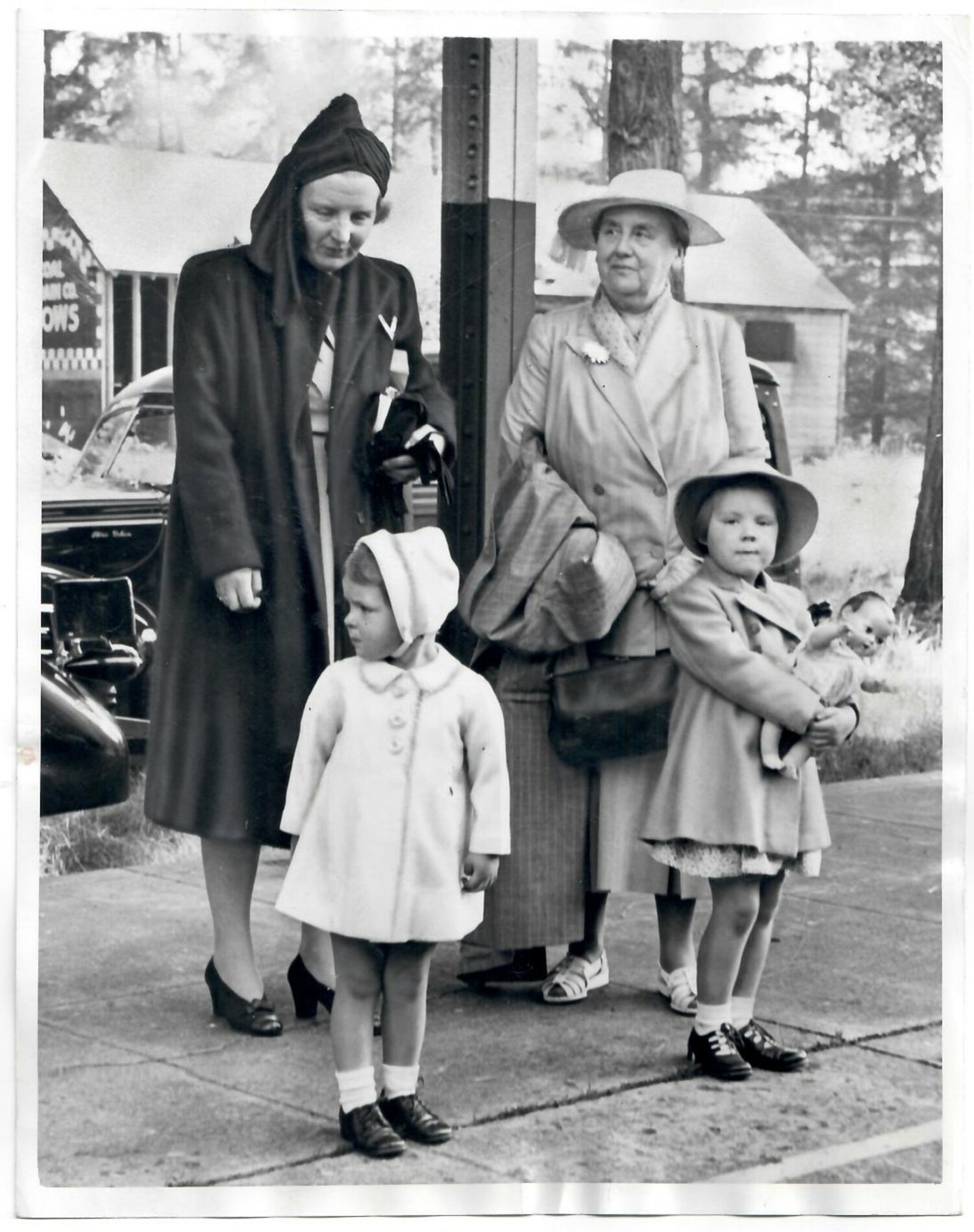 Photograph of Queen Wilhelmina, Princess Juliana, Princess Beatrix and Princess Irene in Stockbridge, Mass, USA. The Queen is wearing a margriet (daisy) brooch, while Princess Juliana has a V-brooch, 24 June 1942 (TRC 2020.3190). For more information, click on the illustration.Prinses Irene Brigade
In May 1940 some 1,200 Dutch soldiers arrived in Great Britain from the occupied Netherlands. They, and many others who followed, became known informally as the "Dutch Legion". In August 1941 they were included in the new Prinses Irene Brigade (P.I.B.), named after one of the daughters of crown princess, Juliana. During the war, the P.I.B included soldiers from many countries, but the core remained Dutch.
In August 1944 they landed in northern France, and they were among the first military units to move into the south of the Netherlands in September 1944. On 8 May 1945, to mark the official surrender of the German forces, many of them drove from Arnhem via Alphen aan den Rijn and Leiden to The Hague.
Dutch East Indies
The Dutch East Indies, now known as Indonesia, constituted a colony of the Netherlands since the 17th century. After the occupation of the Netherlands by Nazi Germany, the Dutch were no longer capable of defending their colony against Japan, which was an ally of Germany and was striving to establish a greater Asian empire. In March 1942, Japanese troops occupied the Dutch East Indies.
Dutch families were split up: the men (often Dutch government officials or members of the armed forces) were sent to prisoner of war camps where they were driven into forced labour (including Burma), while the women and children were placed in internment camps, commonly known as Jappenkampen.