
 National festive women's costume designed mid-19th century by the Icelandic painter, Sigurdur Gudmundsson.Shelley Anderson, TRC volunteer, recently visited Iceland. On Sunday, 21st October, she writes:
A visit to the National Museum of Iceland in Reykjavik is a must for anyone who loves textiles. While there is no specific section devoted to textiles, the museum’s third floor houses the permanent exhibition “Making of a Nation: Heritage and History of Iceland”. Some beautiful examples of costumes, altar frontals, ecclesiastical clothing and domestic textiles are scattered throughout this display.
Two costumes struck me in particular, as they illustrate the close connection between dress and identity. The first is a pre-1860 ensemble that was considered the national festive dress for women. Called faldbuningur, it includes a high white headdress with a multicoloured silk kerchief; another silk neckchief (dated to 1780-1800); a jacket worn over a sleeveless bodice, both of black, woollen broadcloth with embroidered borders; a velvet belt, with a large white handkerchief in drawn thread technique hanging from it; and a blue broadcloth skirt and apron.
The skirt and apron were especially interesting to me, because both the owner and the woman who made the decorative needlework are recorded. The skirt was made around 1798 for Valgerdur Jonsdottir, who later married a bishop. The woman who did the split stitch embroidery on the garment was Gudrun the Elder, who was born in 1740. It’s striking how many female embroiderers are known by name in Iceland. In fact, one such famous needle woman, Ragnheidur Jonsdottir (1646-1715), is still honoured today by being depicted on the 5000 kroner Icelandic bank note.
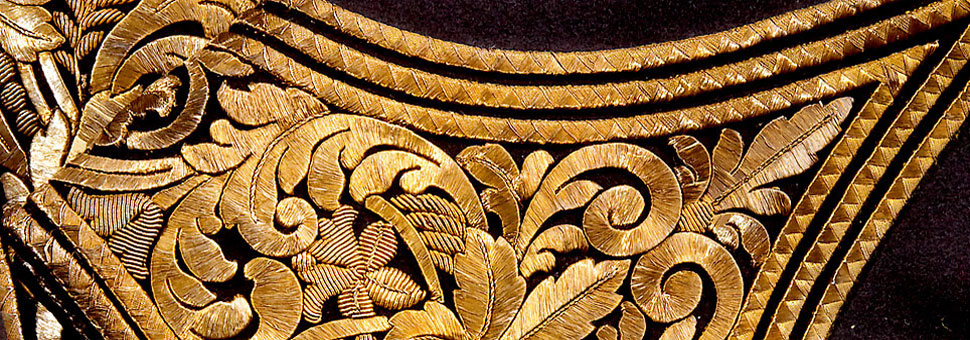
This form of festive dress had a deliberate make-over beginning in 1858. Nationalism was rising in Iceland, which then was still under Danish rule. A new national dress for women was proposed by the influential painter, Sigurdur Gudmundsson, called the skautbuningur. It was quickly adopted and is still worn on formal occasions by Icelandic women. There is a beautiful example in the National Museum. Again, it is made of black woollen broadcloth, this time skillfully embellished with silver thread embroidery along the edges of the jacket and skirt. A pendant belt, made of silver, is worn around the waist.
The most striking difference between this and the older costume is the headdress. A white headdress with a slight peak is worn, accompanied by a long white veil and a gilded fillet. The Museum’s garment is the oldest known of this type and was made by Sigurlaug Gunnarsdottir, following Gudmundsson’s instructions, in 1860.