
As part of building up the TRC’s reference collection, today Renske, a TRC colleague, and I went to a special textile market in Leiden (29th May) – it occurs twice a year and includes many stalls selling a wide range of woven and printed textiles, tulle and net, machine laces and embroideries, haberdashery (from pins to buckles, via threads of many kinds), knitting yarns, as well as one stall selling leather. Great fun! For the market of 30 October last year we published another blog.
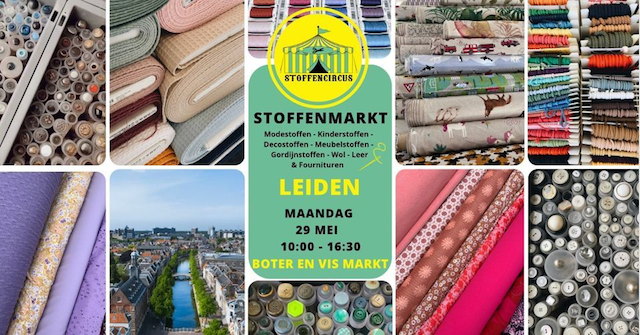 Announcement for the 29 May textile market in Leiden
When I saw the stall I thought: leather, that ticks a box, and some more interesting leather samples may help to expand the leather section of the TRC’s reference collection, something that is important for understanding ancient, historic and modern garments, as well as accessories such as bags, belts and shoes.
The leather on the stall came in the form of large as well as smaller pieces, and large bags filled with scraps. We bought one of the bags for ten euros, a good buy as it contained over thirty different pieces of ‘leather’. As will become clear below, I deliberately put the word leather between apostrophes.
 Some of the 'leather' samples: corium bonded leather with a variety of patterns.I have a basic knowledge of historical and modern leather production techniques, and I need to stress: it is basic. Yet even I could tell there were paper, cloth and plastic versions among the 'leather' scraps in the bag, as well as sheets with plastic laminates with pressed/embossed patterns imitating the ‘grain’ (gland and hair follicles) pattern of various animals.
One piece of crocodile (or was it an alligator?) ‘leather’, for example, was constructed out of (a) a corium layer (sheet) made up of very finely chopped corium fibres and (b) a white, woven (plain weave) textile covered in white plastic. A suitable scale pattern had been embossed into the plastic layer. The two sections were (poorly) glued together and are already coming apart.
Another piece of ‘leather’ was, in cross-section, made up of a corium sheet, a dark layer or junction, and then another corium sheet! An impossible combination in real life.
 Some of the 'leather' samples: corium bonded leather with a variety of patterns.Corium, it should be added, is the layer of tissue under the epidermis of the skin. 'Corium bonded leather' is the industrial name for 'leather' that is principally made up of chopped and reconstituted corium, with a separate layer glued on top with or without a suitable 'leather' surface. There is a clear similarity to laminates used for flooring. All the 'leather' scraps that we bought even smell of leather. Was this smell also industrially added? Some supermarkets, after all, tend to spray pertinent 'smells' around their bread stalls, thus to promote sales.
I just wonder about the quantity of natural products (skin), plastics and adhesives used to make modern leather, whether corium bonded leather or 'real' leather? Let alone recent developments such as the use of apple, grape, orange skins that are ground down, mixed with plastics and then sold as a vegan alternative to real leather. The idea of using the fruit waste in this manner is intriguing, but how much plastic needs to be used to make the product and how long will it last?
 Some of the 'leather' samples: corium bonded leather with a variety of patterns.Anyway, to cut a long story short, I am now talking with a museum colleague who is a specialist in leathers to see if she would be willing to give a leather study day at the TRC here in Leiden. The aim of the day is for participants to learn more about leather, modern versions, how they are made and how to identify the main production techniques. The date of the study day has not yet been fixed, but if there is anyone interested in joining in and having more details in due course can you please let me know as soon as possible?
Out of curiosity, apart from someone like me making a reference collection, who else would buy a bag of leather scraps? What can you do with them? And finally, are there any shoes still made of real leather?
Gillian Vogelsang-Eastwood, 29 May 2023