
The TRC Collection includes textile and sewing tools and equipment such as needles, pins and pin cushions (see a previous blog), as well as scissors and shears. In addition we have a small collection of thimbles of various types, literally from minute silver forms to leather and metal palm versions used by sail makers.
 Kaga yubinuki, Japan, c. 2020 (TRC 2021.1770a).Not long ago we were given some beautiful and unusual thimbles, namely silk wrapped forms from Japan (TRC 2021.1769a, TRC 2021.1770a, TRC 2021.1771a, TRC 2021.1772a, TRC 2021.1773a). These are called Kaga yubinuki and are related to kagari temari, the well-known Japanese wrapped balls, of which the TRC has several in its collection (TRC 2021.1262, TRC 2021.1263, TRC 2021.1264, TRC 2021.1265, TRC 2021. 1266).
 Kagari temari (TRC 2021.1262).The following blog about kagari temari and Kaga yubinuki and their links to temari was written by Naoko Kikuchi, a TRC volunteer who lives in Japan and is actively helping to build up the TRC’s Japanese collection. This has recently been increased, for example, by a kind donation from the Noda family (more details about this donation will be given soon), which was also facilitated by Naoko.
Temari literally means a hand ball in Japanese and there are some variations of temari in terms of materials and production methods. Among them is a kagari temari. Kagari is an adjective form of the verb “kagaru”, which means fixing thread by wrapping around and stitching. The surface of a kagari temari, for example, is wrapped with a variety of threads into a range of patterns that make it appear to be embroidered.
 Four wrapped kagari temari from the TRC collection. Japan, ca. 2020. Photograph by Naoko Kikuchi.
The origin of temari is the kemari, or 'kicking ball' which was made from deer hide and was popular with male aristocrats or samurais until the Kamakura period (the early 14th century). They would toss and pass the ball by foot in a group, trying not to drop it onto the ground. During the Muromachi period (the late 14th century -the late 16th century), some people started to toss the ball upwards using their hands and it was then that the ball started to be called temari ('hand ball').
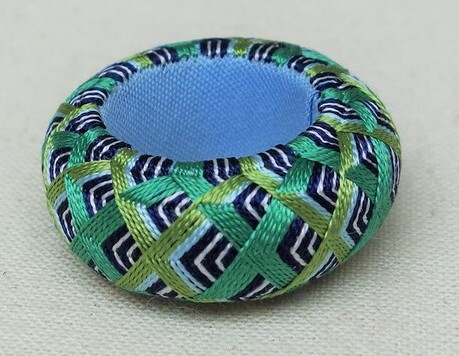 Kaga yubinuki, Japan, ca. 2020 (TRC 2021.1772a).When cotton became widely available in the Edo period (the early 17th century - the late 19th century), people made softer and bouncy balls with cotton, with its surface colourfully decorated with threads, and women and children started to play indoors with temari by bouncing them against the floor.
Many of these balls were made in the Kaga region in western Japan, which was rich with fertile land, and as a result silk was easily available and the kimono industry was thriving.
The Kaga region became well-known for the production of temari balls that were wrapped with silk threads, and it became was a local custom for mothers to teach their daughters how to make temari or to give temari to newborns, wishing them healthy growth.
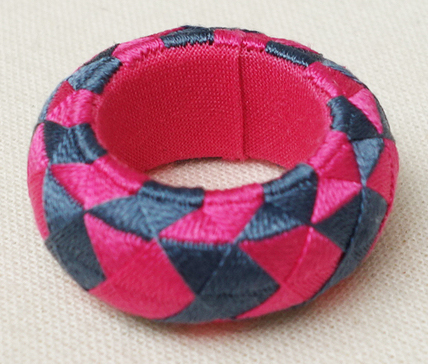 Kaga yubinuki with the yabane pattern, Japan, ca. 2020 (TRC 2021.1773a).Kaga yubinuki is a silk thread thimble that also came from the Kaga region. Seamstresses made colourful yubinuki (thimble) using left-over silk threads in a similar method as with temari-making. During the first three days of the New Year, the seamstresses would make such thimbles for themselves at home in order to advance their sewing skills. They would wrap paper ring thimbles with silk in various auspicious or evil-repellent patterns, such as yabane (arrow’s wing), seigaiha (ocean wave), uroko (scale) and yatara-jima (a striped pattern).
When synthetic materials became available in the mid-20th century, many people started to use them to make temari and yubinuki from foam polystyrene for the core of temari and artificial and synthetic threads such as rayon, nylon and acrylic, as well as cotton and silk threads for the decoration. As for such thimbles, It is easy to sew with them, as their surface is fully covered with threads and a needle end can be put against any place on the thimble, unlike metal thimbles where the needle has to connect with the indentations (knurling).
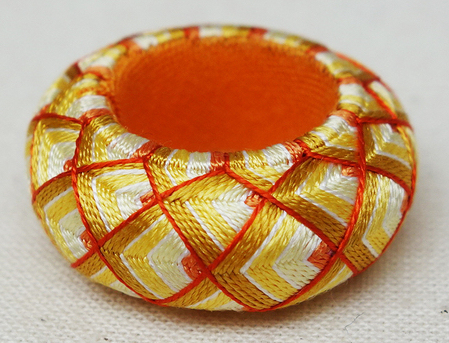 Kaga yubinuki, Japan, ca. 2020 (TRC 2021.1771a).By the 20th century the yubinuki thimble was only still being produced in the Kaga region, but in 2006 Ōnishi Yukiko published several books on the subject in order to preserve and encourage this tradition.
Today people from different parts of Japan enjoy making yubinuki as a hobby to use as ornaments and accessories, rather than as practical thimbles.
Literature:
- Ōnishi Yukiko, Kinu-ito de kagaru Kaga no yubinuki [Kaga thimbles darned with silk threads], Tokyo: NHK Publishing, Inc., 2006 大西由紀子 『絹糸でかがる加賀のゆびぬき』日本放送協会 2006年
- Takahara Hanako, Shin Kaga no yubinuki to hana-temari cho [New Kaga thimbles and Hana-temari Note], Tokyo, Makō-sha, 2017 高原曄子 『新・加賀の指ぬきと花てまり帖』マコー社 2017年
Naoko Kikuchi, 17 July 2021