
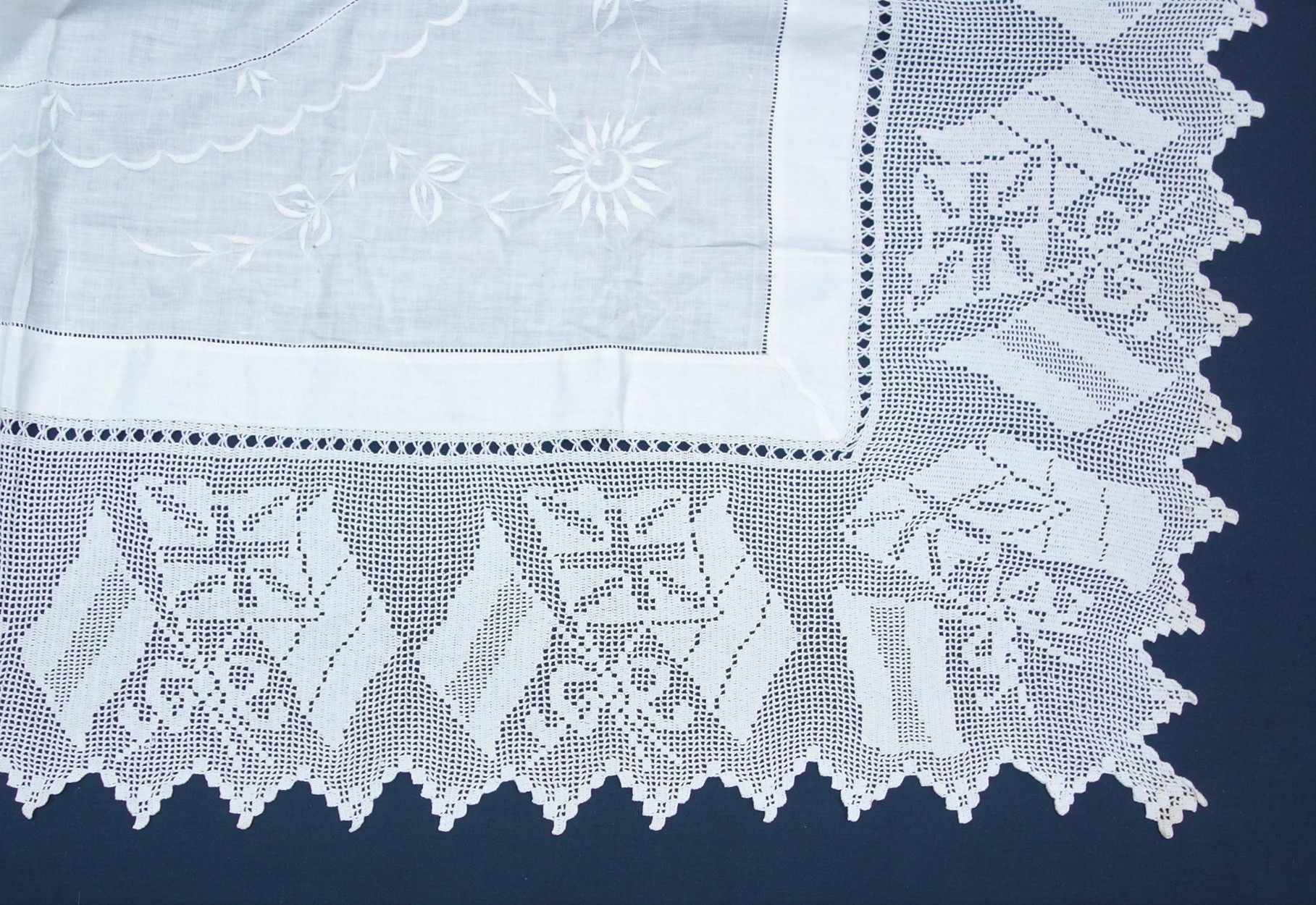
 Corner of a linen tablecloth with a border design of three flag, with the Union Jack in the middle. Early 20th century (TRC 2020.3744).We have just published a blog (18 September 2020) about the donation by Ann Cable of various textiles that used to belong to her mother, Constance Whitehead. In particular, we described one item, a woollen wall hanging with a design by the famous Dutch artist, Maurits Escher. In this blog attention will be focussed on a white tablecloth (TRC 2020.3744) with a deep, crochet border.
Initially Ann was not going to donate the tablecloth, which she remembers as always being at her mother’s home and which was, perhaps, a little too ‘ordinary’. But we had said to bring everything and to decide together what the TRC would be interested in, so she brought the tablecloth anyway. We are really glad that she did, as this cloth may reflect a dramatic episode in European history, and is also linked to the TRC’s current exhibition about textiles and war.
In general, this type of linen tablecloth was very popular in the early decades of the 20th century and women spent many hours crocheting the borders with white cotton yarn, using their own patterns and those printed in specialist books, magazines and leaflets.
The design on Mrs. Whitehead’s tablecloth, at first glance, seemed to be of abstract shapes, but on closer examination it turned out to be based on a repeating design of a central flag with overlapping crosses, then to the right there is a flag with three vertical bands and to left, one with three horizontal bands. All the flags are fastened together with a long ribbon tied into a bow.
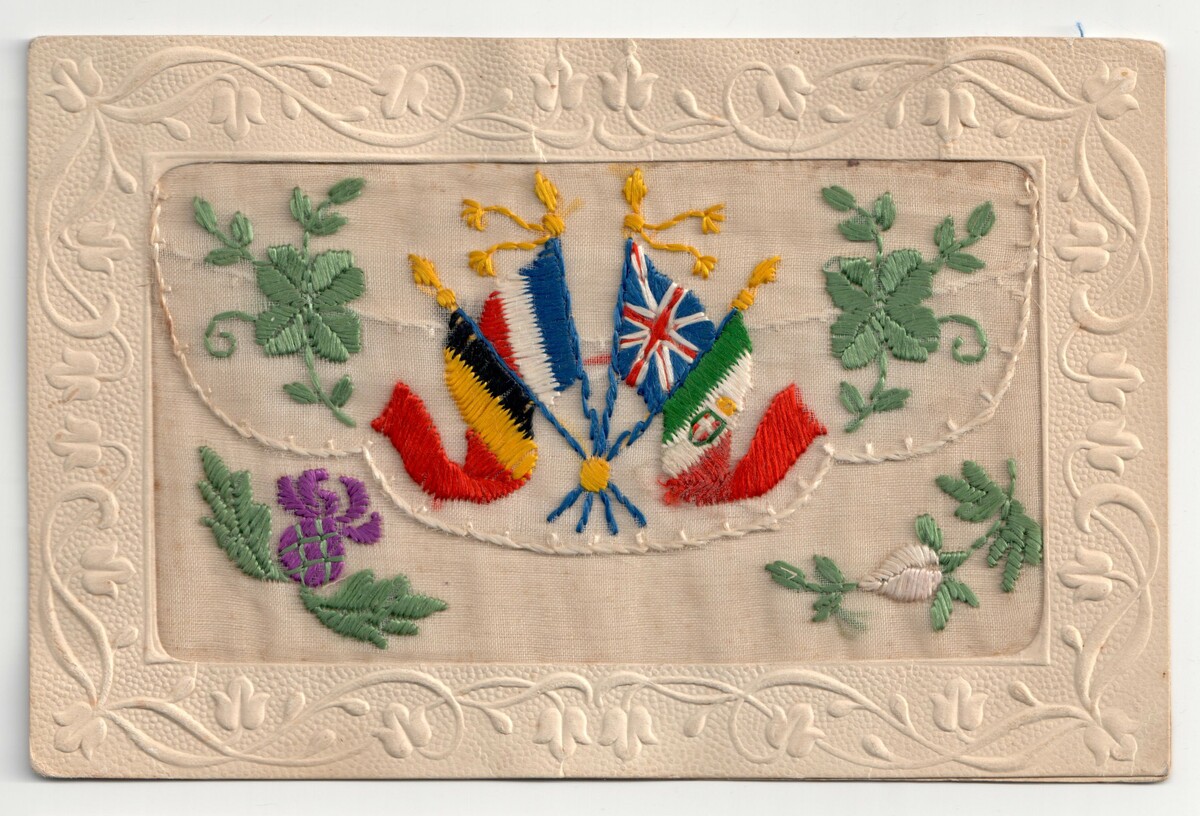 Machine embroidered postcard from the First World War, with flags from various allied nations (TRC 2015.0419).It is very likely that the central flag represents the British Union Jack, but can the two other flags be identified, even assuming that they do represent a particular national flag. The one to the right, with the vertical stripes, may be the French, or perhaps the Belgian flag, while the other one, with the horizontal stripes, may be that of Russia.
If this identification is correct, and it seems reasonable, then it would mean that the tablecloth can be dated to the period of the First World War (1914-1918) and was probably made in Britain, or at least by a British national. An obvious ‘missing’ flag, however, is the ‘Stars and Stripes’ of the United States, which commonly occurs on First World War memorabilia. The lack of this flag would suggest that the tablecloth dates to between 1914 and 1916 or perhaps very early in 1917 as the Americans entered the war in the April of that year. An intriguing memento indeed of a European war that took place over one hundred years ago.
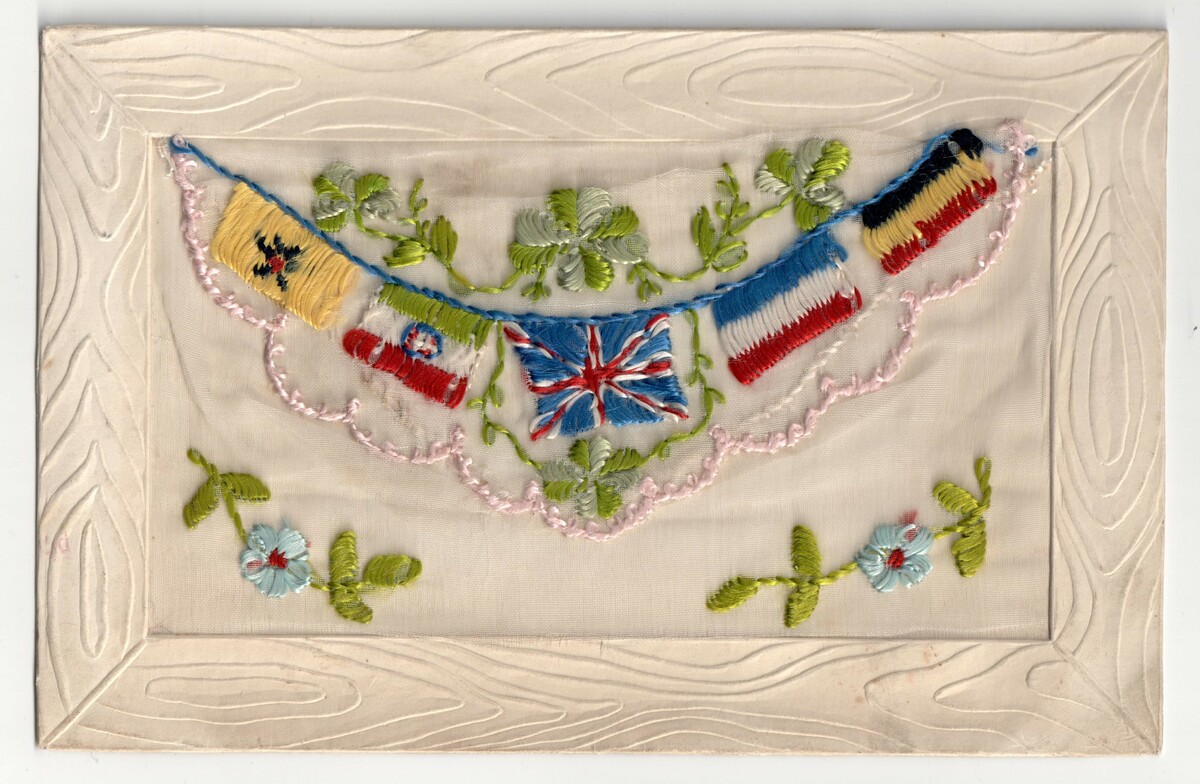 Machine embroidered postcard from the First World War, with flags from various allied nations. The Belgian and the French flags to the right are worked with horizontal, instead of vertical stripes (TRC 2015.0448).In the past, the TRC has paid attention to a more well-know textile item from this period of conflict, namely the embroidered postcards (see a TRC online exhibition), many of which include a range of flags from the Allies. I had never heard of tablecloths with patriotic, crocheted borders, but it makes sense and a quick check online produced a tablecloth in the National Museum of Wales (acc. no. F09.10) that celebrated the end of the war and ensuing peace. The design is also very similar to one published in the Women’s Weekly of April 1919.
If anyone has further information about this or similar crochet designs can they please get in contact with us at Dit e-mailadres wordt beveiligd tegen spambots. JavaScript dient ingeschakeld te zijn om het te bekijken. ?
Gillian Vogelsang, 19 September 2020