• F1
  • F2
  • F3
  • F4

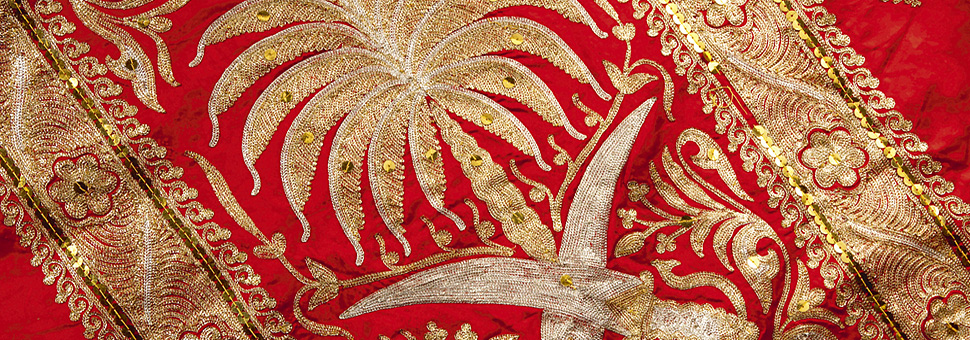
(by Minsook Kang, 14 October 2026) When preparing a mini exhibition at the TRC, a selection of Buton sarongs was brought together to explore the sarong as a form of embodied and transmitted knowledge. This blog introduces the exhibition put together by Minsook Kang, TRC intern and provides deeper context concerning Buton sarong traditions - tracing how patterns, motifs, weaving practices, and memories are transmitted across generations through speech, observation, and the hands. Rooted in a strong oral tradition, the sarong emerges as a living textile language, shaped by everyday life, nature, and generations of makers.
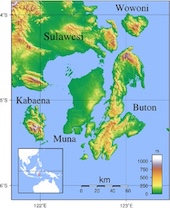
Map of Buton island, Sulawesi, Indonesia.Map of Buton island, Sulawesi, Indonesia.Minsook Kang is a visual artist and researcher currently studying Textile and Text (TXT) at the Gerrit Rietveld Academie in Amsterdam and working as an intern at the Textile Research Centre (TRC). Her practice explores stories, memory, and embodied knowledge through forms of care, attention, and material engagement, working across textiles, moving image, installation, and publication.

Buton sarongs and the “Language of Hands”

This mini exhibition showcases Indonesian TRC textiles and links them with a project called Native Tongue, bringing together the oral language of the Cia-Cia indigenous community in Baubau, on Buton Island in Southeast Sulawesi, Indonesia and the textile traditions of the Buton region.

Native Tongue began with the story of the Cia-Cia language and the adoption of Hangul, the Korean alphabet, as a writing system in 2009, in an effort to support the preservation of a predominantly oral language. When I first encountered this story, I was interested in the relationship between oral language, writing, and cultural preservation. However, after visiting Buton Island, I began to realise that the narratives I had encountered from outside the region could not fully describe the complexity of its linguistic and social realities.

During my visits, I encountered language being lived in many different ways, through conversations, songs, prayers, stories, and everyday interactions. This gradually shifted my research. I became less focussed on documentation alone and more interested in how knowledge, memory, and cultural practices are transmitted through the body.

This led me towards Buton’s textile traditions, particularly the Buton sarong, a large length or tube of fabric wrapped around the waist and worn as a skirt or lower-body garment. Through conversations with local residents and weavers, I observed weaving processes and listened to stories about particular patterns and motifs. I began to realise that the names and meanings of these motifs were not always something that could be traced through written sources. Instead, they often existed in people's memories and continued to circulate through conversation and practice.

For this exhibition, I therefore approach these stories not as fixed or definitive historical facts, but as forms of living oral knowledge that I encountered during my fieldwork. I wanted to bring together objects from the TRC collection with sarongs that I encountered and collected during my fieldwork in Buton, and to explore what they might reveal about nature, memory, everyday life, and what I have come to call the “language of the hands.”
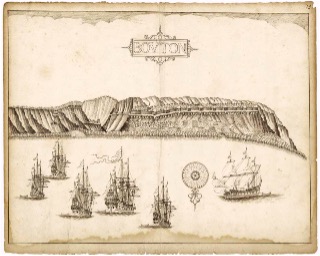
Fig. 2. Dutch ships in the roads of Baubau, Buton,1650.  Retrieved from: https://vocwreckssulawesi.wordpress.com/otter/Fig. 2. Dutch ships in the roads of Baubau, Buton,1650. Retrieved from: https://vocwreckssulawesi.wordpress.com/otter/Indonesian textile culture and the historical crossroads of Buton sarongs

Indonesia is home to an extraordinary diversity of islands, communities, languages, and textile traditions. Travelling through Buton, I became increasingly aware of how this diversity is also connected to a much longer history of movement and exchange. Within this landscape, Buton occupies a distinctive position within the maritime history of Southeast Asia. From the sixteenth century onwards, Baubau, the centre of the Sultanate of Buton, developed as an important node within maritime trade networks connecting different parts of Southeast Asia and the wider Indian Ocean.

Spices, weapons, textiles, and other goods travelled through these networks, bringing different cultural influences into contact with local traditions. Buton also had complex relationships with the Dutch East India Company (VOC) and later colonial authorities.

At the same time, I was struck by the long history of textile production on Buton itself. One important example is the Kampua, a woven textile that was historically used as a form of currency. It circulated as a medium of exchange for centuries before its official use as currency was discontinued in the nineteenth century. The history of the Kampua shows how closely weaving was connected to the economic and social life of Buton.
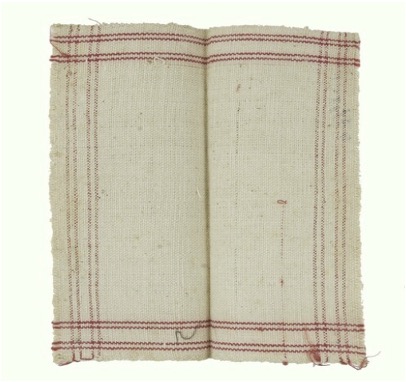
Fig. 3. Kampua textile from the Wereldmuseum collection, Rotterdam. Retrieved from: https://collectie.wereldmuseum.nl/#/query/fbc3d370-319d-4d3f-8fc7-0d2bef9780a7Fig. 3. Kampua textile from the Wereldmuseum collection, Rotterdam. Retrieved from: https://collectie.wereldmuseum.nl/#/query/fbc3d370-319d-4d3f-8fc7-0d2bef9780a7Yet despite this history, I found that Buton textiles have received relatively little attention compared with textiles from other Indonesian regions. Even within international textile collections, including the TRC collection in Leiden, textiles from Sulawesi regions such as Toraja are much more extensively represented and documented than those from Buton.

Sarongs and motifs: Translating everyday life, religion, and nature

The sarong is widely worn across Southeast Asia, but during my time in Buton I came to understand that it carries meanings beyond its function as clothing. It is a practical garment that protects the body from the intense tropical sun, but it is also closely connected to everyday life and religious practice.

When the call to prayer (Adhan) marks the rhythm of the day, people wrap themselves in a sarong before joining prayer. For men, particularly when attending Friday prayers at the mosque, the traditional sarong remains an important part of dress.

Living closely with the body, Buton sarongs also carry a subtle social language through its colours and patterns. Traditionally, checked patterns have been associated with men's sarongs, while vertical stripes are associated with those worn by women. According to the local accounts I encountered, combinations of colour and pattern may also communicate aspects of age, gender, or social position. For example, I was told that a sarong combining a black ground with silver-coloured threads could be associated with young unmarried women.
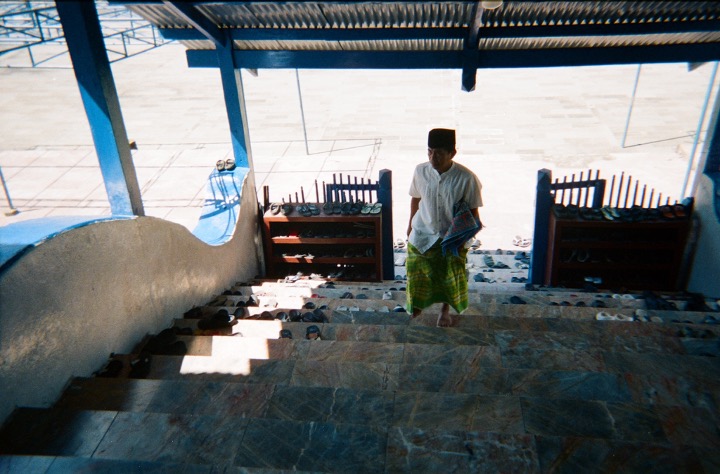
Fig. 4. A man wearing a Buton sarong on his way to the mosque. Photograph[h by author.Fig. 4. A man wearing a Buton sarong on his way to the mosque. Photograph[h by author.

I was particularly fascinated by the names given to textile motifs. At first glance, many of the geometric patterns of Buton sarongs appear abstract. But as I listened to weavers and local residents, I began to recognise how closely many of them are connected to the natural and everyday environment. Leaves, flowers, fruits, seeds, and roots are translated into textile patterns. During my fieldwork, I encountered motifs named after coconut flowers, pomegranates, tamarind, guava, jasmine, and watermelon. The watermelon motif, for example, reinterprets the colours associated with the fruit within the particular colour system of the textile.

Other motifs take their names from objects of everyday life, including unexpectedly playful references such as fried eggs and the package of sugar. What stayed with me was the fact that a motif name can survive even when its precise origin or earlier meaning is no longer known. In some cases, people know the name of a motif without knowing exactly what the name originally referred to. Not everything needs to be written down in order to be remembered. Some knowledge travels through speech, observation, repetition, and practice. A motif name can move from one person to another even when its original story becomes uncertain. For me, these motifs form part of a living oral history: knowledge that moves not only from person to person, but from hand to hand.

The making of a sarong

During my fieldwork, I also became interested in the material processes behind the finished sarong. Traditionally, Buton weaving tends to use cotton fibres obtained from locally grown cotton. Today, however, many weavers purchase commercially produced yarns from factories outside Buton, including from cities such as Surabaya. Although hand weaving continues to be practised, the choice of materials has changed. Pure cotton yarn and naturally dyed threads can be considerably more expensive, and weavers therefore use a wider range of commercially available materials.

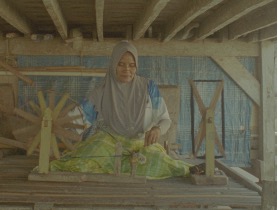
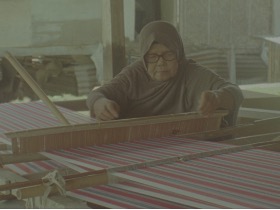
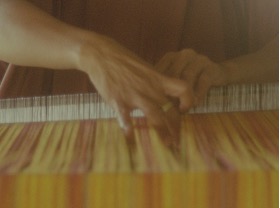
The making of a Buton sarong involves a series of carefully coordinated processes: preparing the yarn, forming the warp, setting it on the loom, and weaving the textile itself. I encountered local terms for these stages:

  • Poburu — preparing the yarn into a bundle
  • Pogantara — preparing the warp
  • Pangururi — stretching and setting the warp on the loom
  • Tanun — the actual weaving process


Fig. 5. Weaving Buton sarongs in a weaving community (from top to bottom: Pogantara, Pangururi, and Tanun). Photographs by author.

A living tradition: Knowledge remembered by the body

One of the things that affected me most during my fieldwork was the way weaving knowledge was transmitted. Buton weaving has traditionally been learned not through written manuals or diagrams, but through the body and through generations of practice. Weavers accumulate knowledge through repeated movements: aligning threads, operating the loom, controlling tension, and coordinating their hands with the rhythm of weaving. The weavers I met often told me that they had learned the practice from their mothers or grandmothers when they were young.

In weaving spaces where mothers and daughters sit side by side at the loom, tools can become carriers of family histories and intergenerational memory. This brought me back to the question that first led me from language towards textiles. Just as spoken language passes from mouth to ear, weaving knowledge can pass from hand to hand and from body to body. This is what I understand as embodied knowledge. If writing records the sound of language, perhaps textiles can record the repeated movements of the hands and the passage of generations.
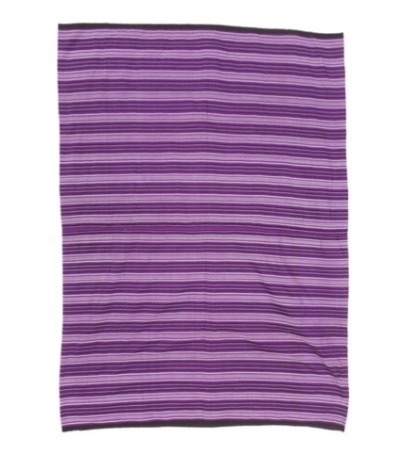
Fig. 6. Hand-woven Buton sarong, cotton, 20th century, Sulawesi, Indonesia (TRC 2022.1474).Fig. 6. Hand-woven Buton sarong, cotton, 20th century, Sulawesi, Indonesia (TRC 2022.1474).Encounters between the TRC collection and my fieldwork

When I asked a local weaver about a motif on a sarong in the TRC collection, she identified it as representing an eggplant. Two sarongs that I brought back from Buton had different colour combinations, but the motif was also described to me as the same eggplant motif. This encounter made me think about how a single motif can be interpreted and transformed differently by different weavers. The motif may remain recognisable, while its colours, proportions, arrangement, and visual character change according to the individual maker, the period in which it was produced, and the weaver's own sensibility.

The subtle differences between the sarong I encountered in different places reminded me that tradition is not a fixed form preserved unchanged over time. Instead, it continues through individual choices, adaptations, memory, and intergenerational transmission. In this sense, the changing nature of textile tradition closely echoes the oral traditions through which many of its meanings continue to circulate.

What Is recorded, and what remains in the hands?

Finding written documentation about Buton sarongs has not been easy. My research has therefore been marked by questions, gaps, fragments, and partial answers. At first, I found these gaps frustrating. Over time, however, I began to wonder whether the absence of written documentation might also encourage another way of looking; one that pays closer attention to what is carried through the body, through making, and through everyday use.

The sarong itself continues to live. It is still worn, made, used, and passed from one generation to another. For me, Buton sarongs are therefore more than a traditional textile. It offers a way of thinking about the relationship between people and nature, the memories embedded in everyday life, and the ways knowledge can move across generations without being fully captured in words or writing.

Written records may fade, deteriorate, or be forgotten over time. Knowledge held in the hands and body can continue through the repetition of making. If writing records the sound of language, textiles can record the repeated movements of the hands and the memory of time. Yet this record is never completely fixed. Every new weaver changes it slightly. A colour may be altered, a motif remembered differently, or a technique adapted. A tool may be passed from a mother to a daughter, while a story survives even when part of its original meaning has been forgotten.

This is what makes Buton sarongs, for me, a living form of language. Its knowledge does not remain only in written records or in the finished textile, but continues through hands, bodies, materials, memory, and use.

Through this exhibition, I invite visitors to look at these textiles not simply as finished objects, but as traces of people, nature, everyday life, memory, and time, and as forms of knowledge that continue to live in the hands.
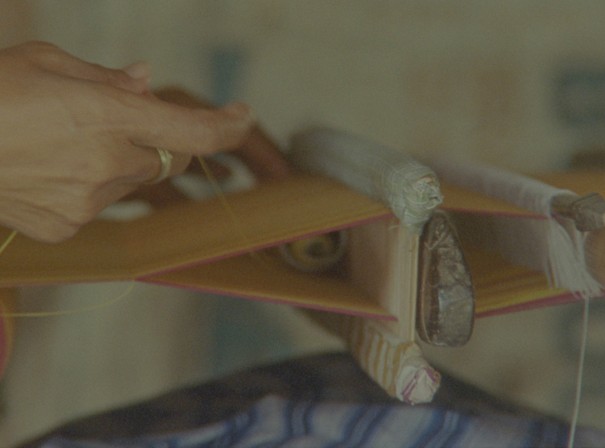
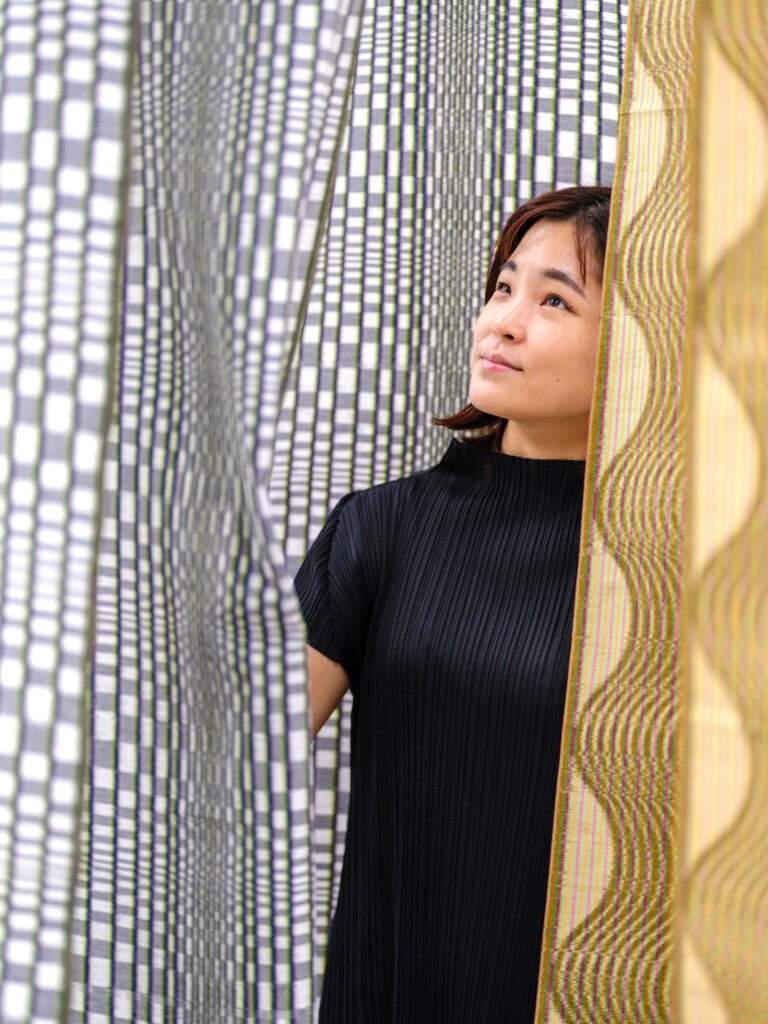
This mini-exhibition at the TRC is curated by Minsook Kang, who is an intern at the TRC from the Gerrit Rietveld Academie in Amsterdam. She is a visual artist and researcher working across textiles, moving images, installations and publications. She explores stories, memory, and embodied knowledge through forms of care, attention, and material engagement. In the summer of 2026 she visited the island of Buton in Sulawesi Province, Indonesia.

Producing sarongs on the island of Buton. Photograph courtesy Minsook Kang.Producing sarongs on the island of Buton. Photograph courtesy Minsook Kang.

A Language of the Hands - Embodied Knowledge and Transmitted Memory in Indonesian Buton Sarongs explores the Buton sarong as a form of embodied and transmitted knowledge.

Drawing on TRC collections and fieldwork in Baubau, the island's capital, the exhibition traces how patterns, motifs, weaving practices, and memories that are  transmitted across generations through speech, observation, and the hands. As a strong oral tradition culture, the sarong emerges as a living textile language shaped by everyday life, nature, and generations of makers.

A Language of the Hands can be visited until 20th of November 2026. The TRC is open every weekday from 10.00 to 15.00.

Tokyo-based textile designer Hana Mitsui. Photograph: www.hanatextiledesign.comTokyo-based textile designer Hana Mitsui. Photograph: www.hanatextiledesign.com(Flora Kovacs-Wester, TRC Fellow, 12 October 2026) As part of my research into Japanese kasuri weaving (see my earlier TRC blog post), I recently had the opportunity to interview Japanese textile designer Hana Mitsui about her practice and her approach to traditional Japanese textiles.

Drawing on her experience with leading fashion and textile houses in Japan and internationally, Mitsui combines traditional weaving techniques with new approaches to materials, patterns and production. During our conversation, Mitsui generously offered to donate a selection of samples from her experiments with Kurume kasuri to the TRC. The donated samples make a meaningful addition to TRC’s existing collection of traditional kasuri textiles and enable us to expand the ways in which Kurume kasuri can be understood and researched within the TRC collection.

Mitsui’s ability to see new possibilities in fabric caught the attention of the fashion world early in her career. While studying at the Royal College of Art in London, Alexander McQueen selected her graduation textile for its Spring/Summer 2015 Paris collection.

Het TRC werkt op projectbasis en met financiële donaties uit officiële, commerciële en particuliere bronnen. De financiering wordt gebruikt voor speciale projecten, het in stand houden van de collectie, het opzetten van tentoonstellingen en algemene lopende kosten. Door de jaren heen hebben we veel Vrienden gehad die het werk van het TRC ondersteunen met donaties, zowel financieel als materiaal voor de collectie.

In de afgelopen 30 jaar is de TRC-collectie gegroeid van veertig items tot meer dan 42.000 gecatalogiseerde items. Sinds 2009 is de collectie ondergebracht bij Hogewoerd 164 in Leiden. De opening van deze site maakte ook de uitbreiding van educatieve activiteiten en tentoonstellingen van de groeiende collectie mogelijk. We bevinden ons opnieuw op een kritiek moment in onze groei. We hebben bijna geen ruimte meer voor de collectie, werkruimte en klaslokaal. We hebben onze vrienden nog meer nodig. Tegelijkertijd proberen we de groeiende collectie en het educatieve programma onder te brengen in onze huidige ruimte EN zijn we op zoek naar een nieuwe ruimte. We zijn voorzichtig in deze moeilijke economische tijden, maar hebben goede hoop in de wetenschap dat een nieuwe ruimte ons vermogen om zelfvoorzienend te zijn zal vergroten, omdat we meer workshops kunnen bieden en efficiënter kunnen werken.

Word een deel van onze toekomst en word lid van ons ondersteuningsnetwerk door Vriend van de TRC te worden. Om onze waardering te tonen ontvangt u 10% korting op artikelen in onze winkel, lezingen, cursussen (m.u.v de intensieve 5-daagse cursussen) en workshops. Daarnaast maken alle leden vier keer per jaar kans op een tombolaprijs.

Jaarlijkse bijdrage is  €75; een levenslang lidmaatschap is €500.

Om vriend te worden van het TRC, neemt u alstublieft contact op met ons op het volgende adres: Dit e-mailadres wordt beveiligd tegen spambots. JavaScript dient ingeschakeld te zijn om het te bekijken. met als onderwerp: Lidmaatschap Vrienden van het TRC.

Fiscaal voordeel van doneren aan TRC Leiden

Stichting Textile Research Centre is officieel erkend als een non-profit organisatie, een "Culturele ANBI" (Algemeen Nut Beogende Instelling) waarbij giften niet onderworpen zijn aan schenkings- of successierechten en fiscaal aftrekbaar zijn. Uw financiële bijdrage aan de TRC als Vriend is aftrekbaar voor de jaarlijkse belastingaangifte, tot 125% van het bedrag voor particulieren en tot 150% voor bedrijven. U ontvangt hiervoor een ontvangstbevestiging van uw bijdrage aan het TRC. Daarna hoeft u alleen nog maar het bedrag van uw schenking aan te geven in uw jaarlijkse belastingaangifte en het vakje “Culturele ANBI” aan te vinken.

Become a friend of TRC

Annual membership fee is €75; lifetime membership fee is €500
reCAPTCHA Selectievakje: Vul uw Site en Secret Key in op de configuratie pagina.


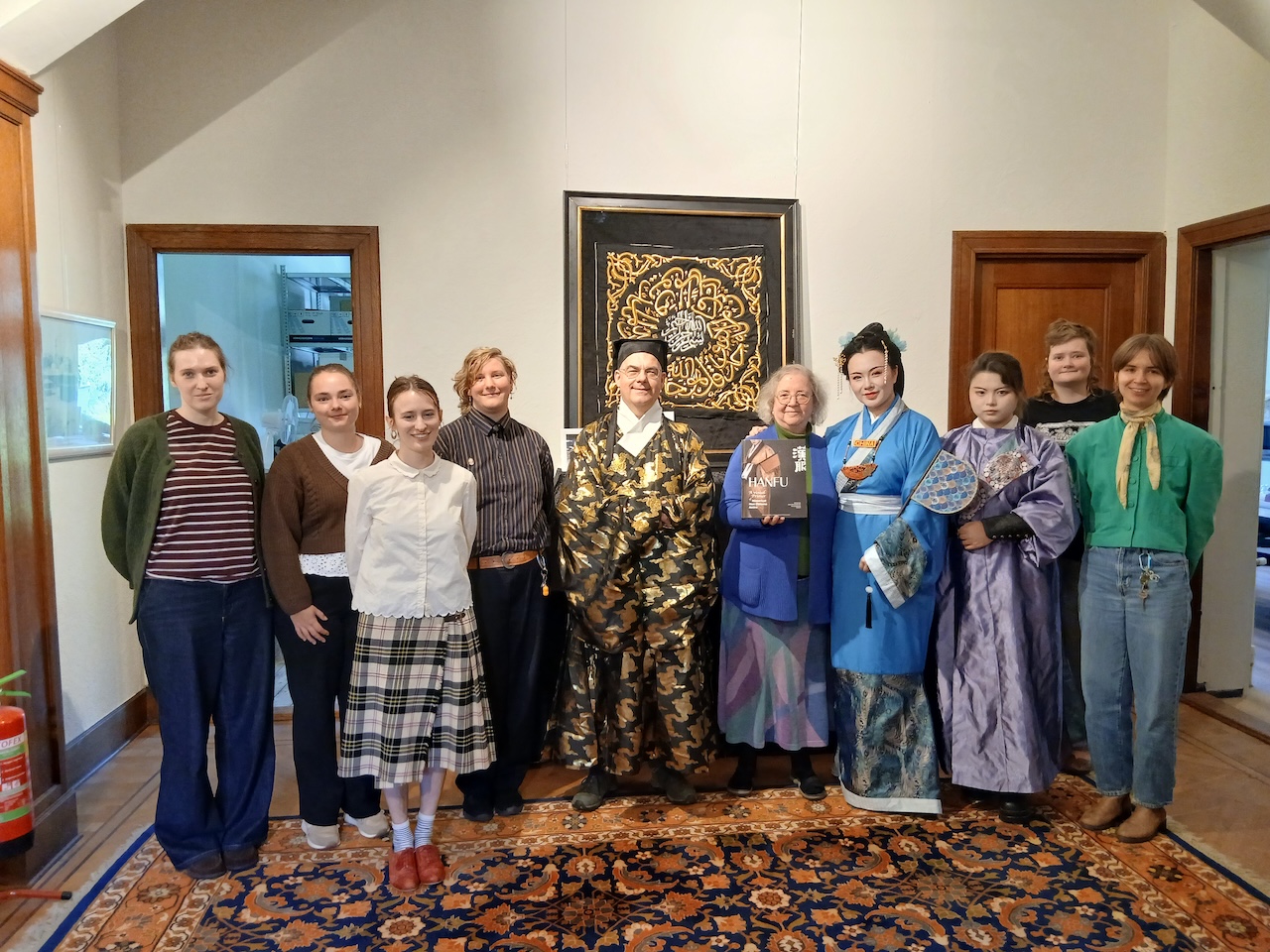
(Gillian Vogelsang, 5 October 2026) A few days ago, Danni Wang, who is of Chinese origin and lives in The Netherlands, came to the TRC with two of her friends, all of whom were dressed in Hanfu. They looked so different and ‘exotic’. And yes, that was the whole point. Hanfu has become more and more popular over the last twenty or so years with many Chinese, both in China itself and among the diaspora, as well as others who love Chinese history and culture.

Our guests in Hanfu clothing at the TRC, 5 October 2026.Our guests in Hanfu clothing at the TRC, 5 October 2026.

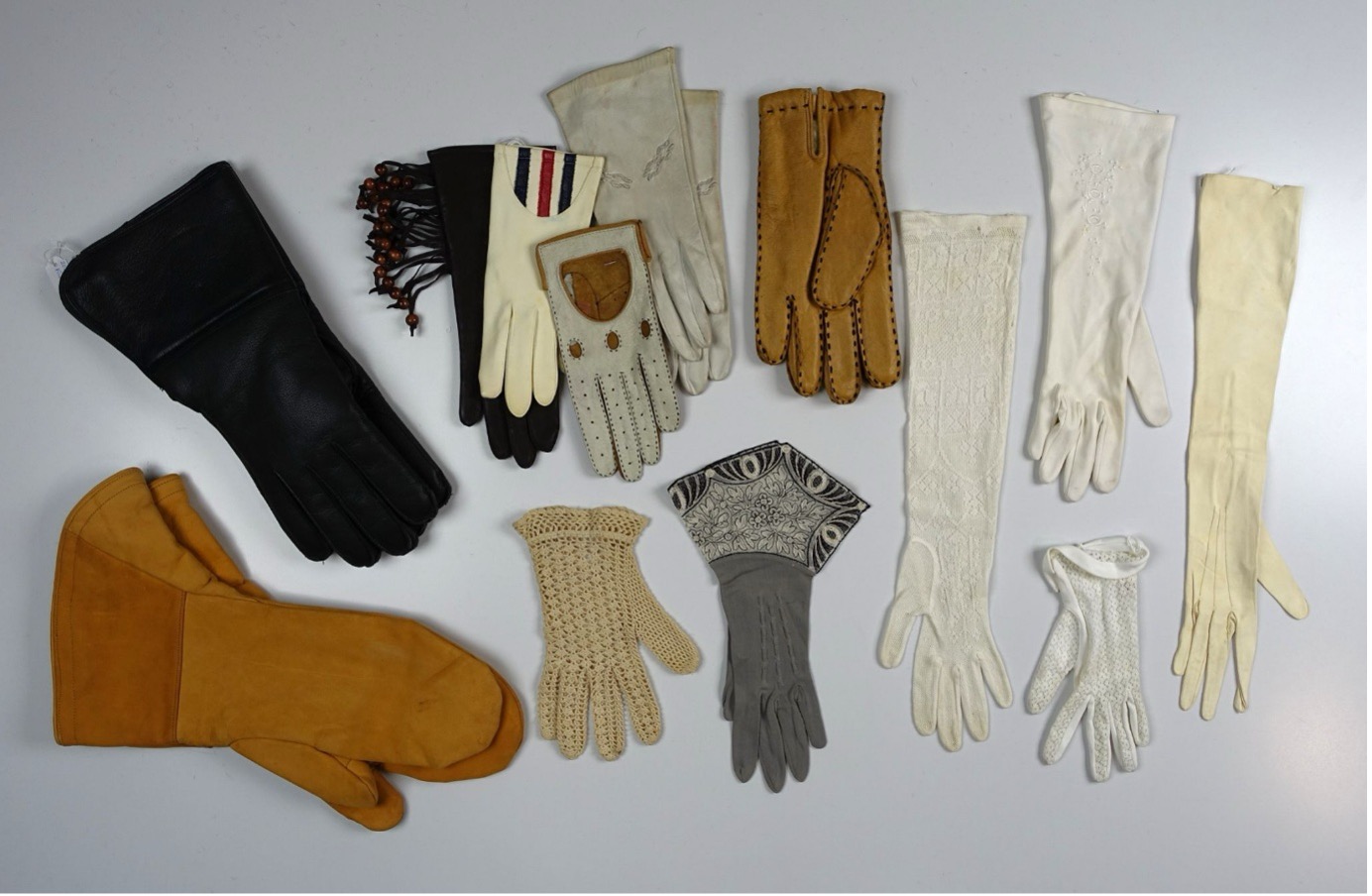
(Emilie Lambert, collection manager, TRC) The TRC houses over 300 pairs of gloves, mittens and gauntlets. They are made of leather, wool or silk, in lace or with net work. They may be knitted, and be practical or purely decorative. The sheer variety, both technically and culturally, is fascinating (Fig. 1). Some of the gloves are highlighted in previous blogs, such as one about Scottish examples, written by Hanke van Prooije in 2025.

Fig 1: Assortment of gloves in the TRC collection showing the wide variety in materials, shape, and decoration used.Fig 1: Assortment of gloves in the TRC collection showing the wide variety in materials, shape, and decoration used.

However, all the items in the collection, which originate from just about everywhere, from Romania to Australia and  Congo, are later than the early twentieth century. Curious about the history of gloves, I browsed the TRC library and quickly found a book (2015b) by Annemarieke Willemsen [current curator of medieval collections at the RMO in Leiden] on medieval gloves, mittens and gauntlets, through which I discovered many intriguing avenues for discussion.

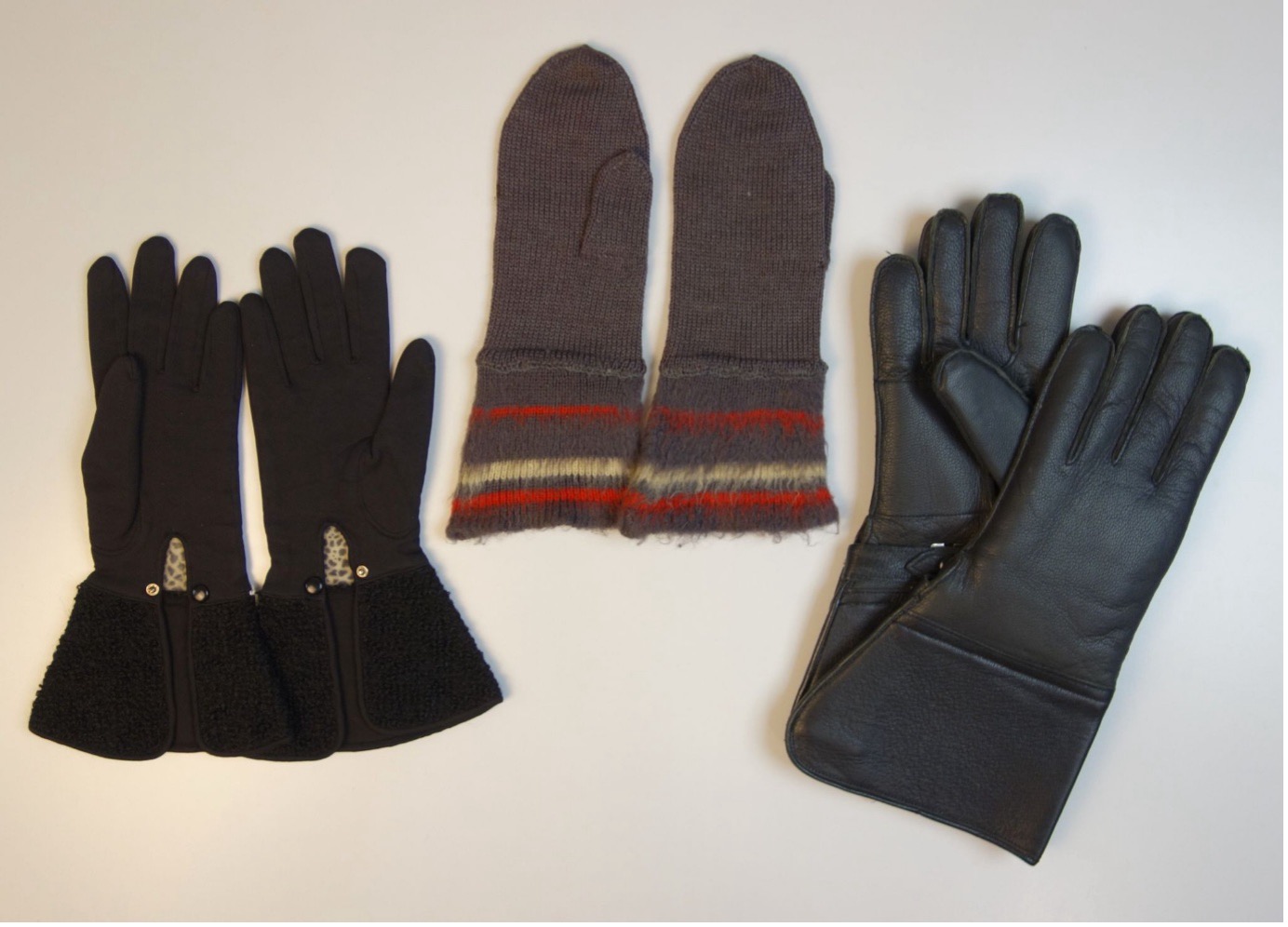
Gloves, mittens & gauntlets (Fig. 2)

It seems that mittens (Dutch: want), whereby all the fingers are enclosed in a single pocket but with a separate thumb, may have preceded the glove with its individual fingers (Dutch: handschoen), perhaps because its construction is simpler. However, both forms have been consistently worn throughout the last few centuries. There were also split mittens, whereby the third and fourth fingers are separated. These were commonly worn in the medieval period by shepherds, who needed slightly greater mobility for their fingers (Willemsen 2015a, p. 19).

The distinction between a glove and another type of handwear, the gauntlet, is primarily one of function. A gauntlet is a type of glove made from heavy or protective material, such as metal or thick, padded leather, with the aim of protecting the hands from injury. While gauntlets are often associated with metal armour used in combat, the term can also extend to heavy-duty gloves used in metalworking, motorcycling or animal handling. In other words, every gauntlet is a glove, but not every glove is a gauntlet.

Protection from the cold is one of the most familiar functions of gloves and mittens. Knitted, needlework, woollen, and cloth examples were often intended to provide warmth, sometimes with additional fur lining. Gloves have also been used as protective equipment in various sports and occupations, comparable to gauntlets. Medical sources even adsvise the use of  gloves made from fish or chicken skin to protect infected or damaged skin during the night (Willemsen 2015a, p. 13).

Not all gloves, however, were primarily practical or protective. Delicate gloves, as said, could function as fashionable accessories and status symbols, as seen in intricate lace or embroidered examples. Gloves could also be very symbolic, such as those of a monarch or priest.

Fig 2: Left to right: a pair of gloves (TRC 2025.0641a-b), mittens (TRC 2007.0762a-b), and gauntlets (TRC 2025.0905a-b)Fig 2: Left to right: a pair of gloves (TRC 2025.0641a-b), mittens (TRC 2007.0762a-b), and gauntlets (TRC 2025.0905a-b)

Early history

Hand coverings were used for many centuries, probably going back to prehistory. They would have been woven with plant fibres or sewn from leather. Gloves are frequently mentioned  in Classical Antiquity, but hard evidence of their use before then is scarce, particularly as they were made of degradable materials.

Many sources note the earliest archaeological example of a surviving glove comes from the tomb of Tutankhamun. He would have worn these ceremonial linen gloves sometime before his death in 1323 BC (Redwood, p. 7). This draws an interesting link to the TRC as our director, Dr Gillian Vogelsang-Eastwood, extensively studied the Tutankhamun textile finds (1999).

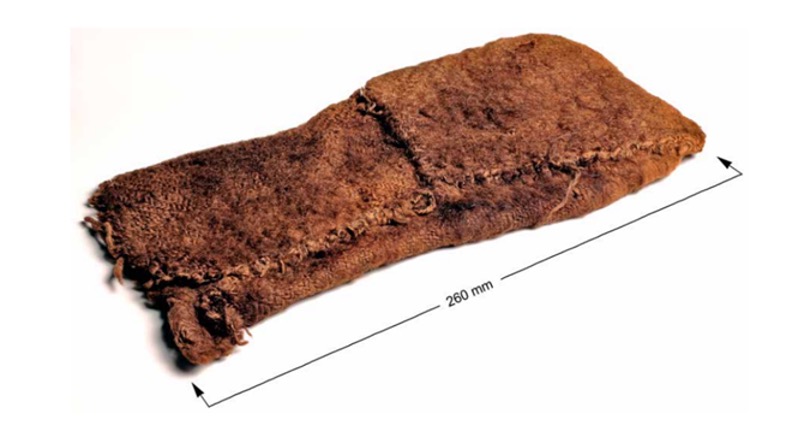
Willemsen’s book also goes into detail about archaeological finds in The Netherlands. The oldest example - a thumbless woollen and knitted mitten from Dorestad (near Nijmegen) dates to 800 AD (Fig. 3). Thanks to the Dutch wetlands, many more woollen and leather gloves were preserved through the centuries, many being found in Amsterdam and Dordrecht. 

Fig. 3: The oldest glove found in the Netherlands, dating to ca. AD 800 (Willemsen 2015a, p. 5).Fig. 3: The oldest glove found in the Netherlands, dating to ca. AD 800 (Willemsen 2015a, p. 5).

Various fashions

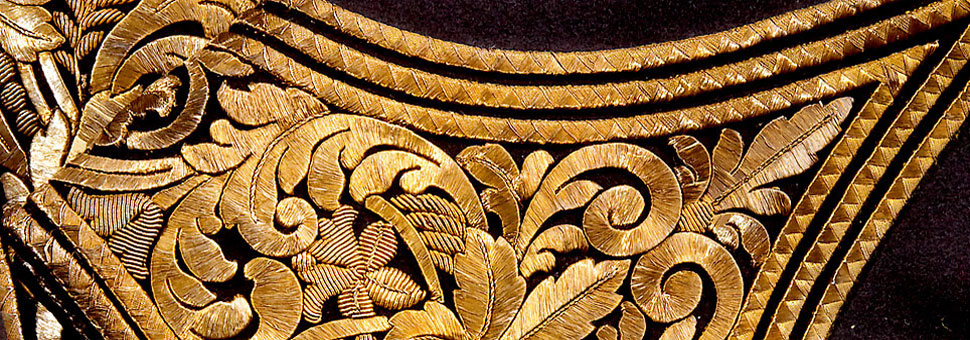
Gloves were conveyors of fashion and status. It would be wrong not to mention the elaborately decorated gloves in prestigious, 17th-century royal fashion with densely embroidered cuffs, made with silver, gold, and coloured thread. Such gloves would have cost a small fortune.

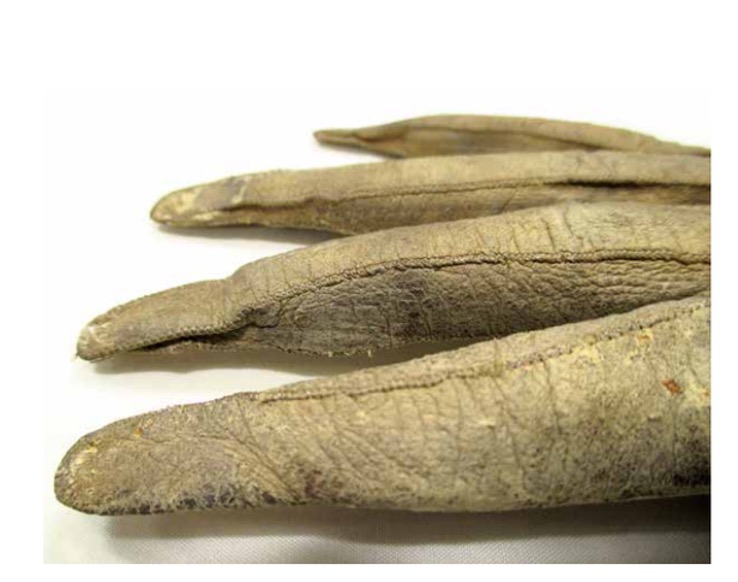
One style that really stood out to me was that of artificial finger-lengthening. During the reign of Queen Elizabeth I, in late 16th-century Britain, it was fashionable to elongate a glove’s fingertips for a centimetre past the reach of each finger to create the illusion of longer, slimmer fingers (Fig. 4; Willemsen 2015a, p. 14).

Fig. 4: Elongated fingertips on 17th-century glove (Willemsen, p.15).Fig. 4: Elongated fingertips on 17th-century glove (Willemsen, p.15).

Production

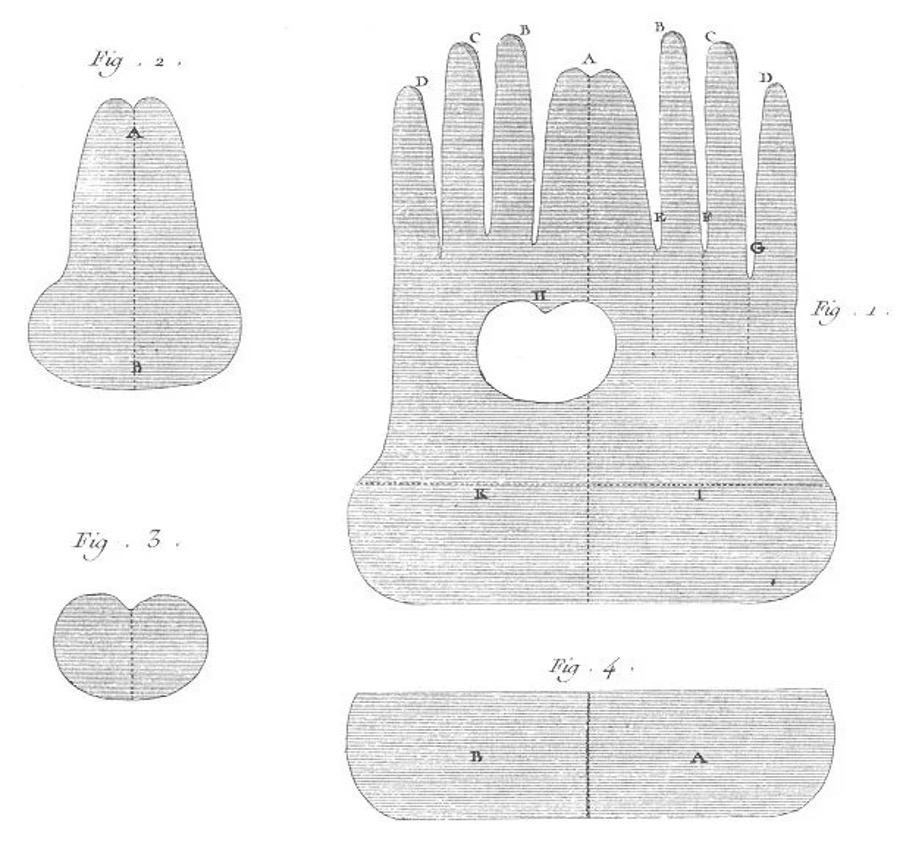
Leather mittens and gloves were made to fit the individual. They were usually constructed by cutting a ‘double glove’ – two handprints conjoined to avoid the need of sewing one seam. Then a separate thumb was added (Fig. 5). Sheep and goat skins were common. Deerskin was used by the wealthy (Willemsen 2015a, p.12).

Gloves were for a long while produced in small workshops, specialised only in glove making, or in combination with other fine leatherwork. Production then moved into large factories, although throughout the 19th century the stitching of gloves was outsourced to women (gloveresses) and children who worked from home to gain extra income. The sewing machine drastically changed the industry, and most glove production nowadays is completely carried out in factories. They are also made in only a few sizes, and it is now difficult to find someone to make personalized gloves.

Most gloves were everyday items and they would get worn, so it is not uncommon for them to be patched and repaired repeatedly.

Fig.  5: Glove sewing pattern showing the double-hand construction with separate thumb piece (https://www.18thcenturynotebook.com/mens-leather-gloves)Fig. 5: Glove sewing pattern showing the double-hand construction with separate thumb piece (https://www.18thcenturynotebook.com/mens-leather-gloves)

Symbolism

There is also a whole world of symbolism when it comes to gloves, and this aspect differs greatly throughout cultures and time. Some general themes are still familiar to us and some are completely obscure. In many circumstances the gloves provide a physical and symbolic barrier between an individual and the action they take - think of a judge, or executioner (Willemsen 2015a, p. 30). In religion too, liturgical gloves indicate the sacred power in the hands rather than those of the preacher (Willemsen 2015a, p. 32). In courting, one removes gloves and presents a bare hand to kiss in greeting, and keeping gloves on would be seen as a sign of hostility. Additionally,“a woman dropping her glove could be understood as a woman offering her body” (Willemsen 2015a, p.15). In combat too, throwing the gauntlet would mean picking a fight. The variation here really shows how aspects of dress have many cultural effects.

Conclusion

I thoroughly enjoyed this exploration of gloves and their history. And as I was talking about it, I was enthusiastically handed a handful of newly donated gloves to add to the catalogue!

Sources

  • Redwood, Mike (2016), Gloves and Glove-making. London, Bloomsbury.
  • Vogelsang-Eastwood, Gillian (1999). Tutankhamun's Wardrobe. Garments from the Tomb of Tutankhamun. Rotterdam: Barjesteh van Waalwijk van Doorn
  • Willemsen, Annemarieke (2015a), 'The Geoff Egan Memorial Lecture 2013. Taking up the glove: finds, uses and meanings of gloves, mittens and gauntlets in western Europe, c. AD 1300–1700,' Post-Medieval Archaeology, 49:1, 1-36.
  • Willemsen, Annemarieke  (2015b), Van Hand tot Hand. Handschoenen en Wanten in de Nederlanden vóór 1700. Leiden: National Museum of Antiquities.

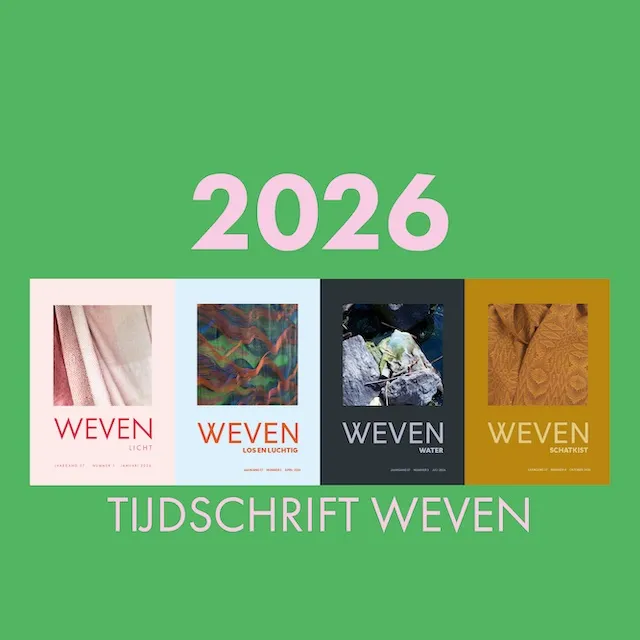
Birgitta de Leeuw wrote an article about the TRC for the journal Weven (No. 4, 2026, pp. 16-18). She is a Dutch creative facilitator, consultant, author, and visual artist focusing on both personal growth and societal and organizational change. Her work lies at the intersection of social innovation and creative expression.

Her article about the TRC appeared in the official and best-known trade magazine for weavers in The Netherlands, published by the organisation Weefnetwerk. It is published four times a year, with each issue covering a specific theme.

A PdF file of the article can be downloaded here.

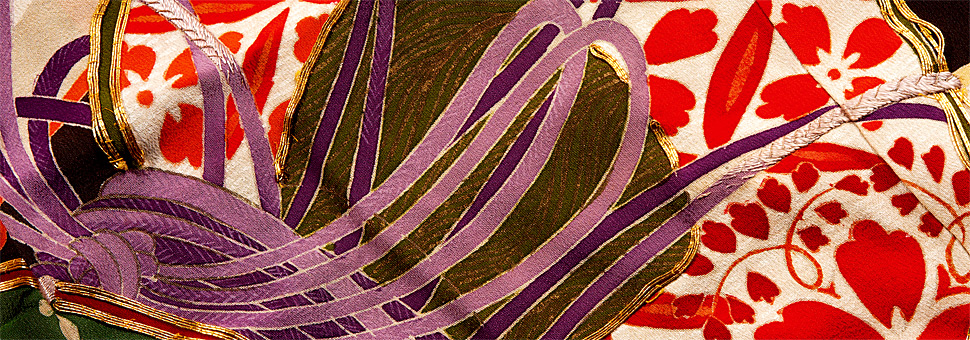
Moroccan kaftan made from a Japanese obi (sash), 1950s (TRC 2001.0074).Moroccan kaftan made from a Japanese obi (sash), 1950s (TRC 2001.0074).The TRC collection of textiles, clothing and accessories from around the world was started in 1997 with 43 pieces from Afghanistan, Egypt and Syria. Since then it has grown to over 56,000 items (26 September 2026), almost all of them have been catalogued and most of them photographed. All information is accessible on the TRC website (click here for the online catalogue).

The items come from diverse backgrounds with respect to time and place. Some of the items have been purchased, but the vast majority has been collected during fieldwork or very kindly donated by various institutions and private donors. The TRC  is a good example of Citizen Culture and Heritage at work!

The collection has no boundaries with respect to geography or time. It ranges from Afghan embroidery, German Lederhosen, Indonesian batiks, historical textiles from Leiden, to delicate silks from Renaissance Italy and spinning and weaving equipment from the Andes.

Subcategorieën

Zoek in TRC website

Contact

Boerhaavelaan 6
2334 EN Leiden.
Tel. +31 (0)71 5134144 (kantooruren)  
office@trcleiden.org

Het TRC is elke dag geopend tussen 10.00 en 15.00 uur.

facebook 2015 logo detail


instagram vernieuwt uiterlijk en logo


Bankrekening

NL39 INGB 0002 9823 59, t.a.v. Stichting Textile Research Centre.

Financiële giften

Het TRC is afhankelijk van project-financiering en privé-donaties. Al ons werk wordt verricht door vrijwilligers. Ter ondersteuning van de vele activiteiten van het TRC vragen wij U daarom om financiële steun:

Giften kunt U overmaken op bankrekeningnummer (IBAN) NL39 INGB 000 298 2359, t.n.v. Stichting Textile Research Centre. BIC code is: INGBNL2A

U kunt ook, heel simpel, indien u een iDEAL app heeft, de iDEAL-knop hieronder gebruiken en door een bepaald bedrag in te vullen: 


Omdat het TRC officieel is erkend als een Algemeen Nut Beogende Instelling (ANBI), en daarbij ook nog als een Culturele Instelling, zijn particuliere giften voor 125% aftrekbaar van de belasting, en voor bedrijven zelfs voor 150%. Voor meer informatie, klik hier.