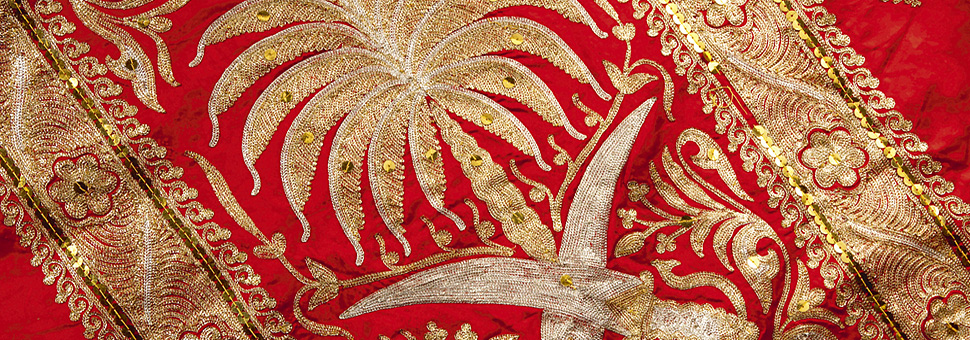

 Sample of worsted cloth (stuff) with narrow black stripes on a purple ground. Norwich, 18th century (TRC 2023.0877).by Willem Vogelsang, 12 July 2024
Last year Dr Michael Nix from Norwich, England, gave a lecture at the TRC in Leiden about historical textiles from Norwich and their connections with the Netherlands, in particular with the historical town of Leiden.
My attention was drawn to the terminology he used for some Norwich textiles made from wool, in particular his use of the two words ‘stuff’ and ‘cloth’. I was intrigued. The English ‘stuff’ has various meanings (compare ‘I am stuffed’), but as a term for a specific type of textile, I was wondering whether there was a link with the common Dutch word for textile, namely stof.
According to Dr Nix, the English word stuff is an old word for a fabric made from combed wool fibres, never fulled. They produce a thin, fine and strong thread, for instance used for men’s suits. The textiles are generally known as worsted fabrics (named after the village of Worstead in East Anglia, not far from Norwich). The word cloth, on the other hand, is often specifically used for textiles made from carded wool, often fulled. This fabric is soft and fluffy and used for items such as blankets, jumpers, scarves, etc.
Yet, it is not that straightforward. Historical records indicate that the word stuff was also sometimes used for textiles that were made of other types of fibres, such as a mixture of combed and carded wool, or even of combed wool and silk.
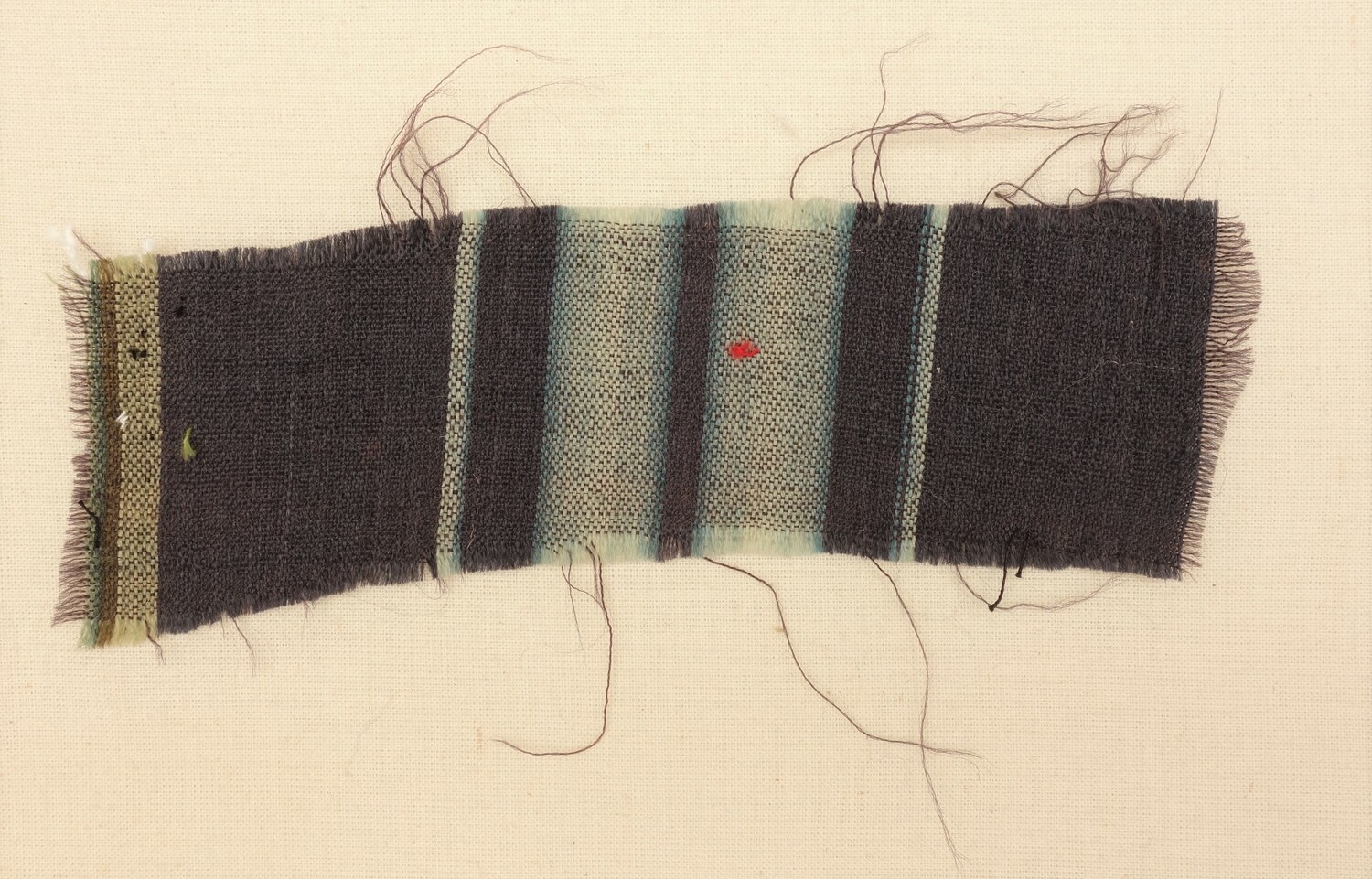 Sample of worsted cloth (stuff) with shaded (ombré) light blue stripes alternating with dark blue stripes of varying widths. Norwich, 18th century (TRC 2023.0876).
To confuse matters even more, wool fabrics made from carded wool (‘cloth’) are often referred to as woollen, while fabrics made from combed wool (the archaic ‘stuff’) are still formally listed as ‘worsted’, rather than wool or woollen. In old commercial reports there are accordingly frequent references to “woollen cloths and worsted stuffs.”
As an aside, the gowns worn by English lawyers, made of worsted wool, are still described as stuff gowns, different from the gowns worn by lawyers of King’s Counsel, which are made of silk (and hence the lawyers are commonly called ‘silks’). Actually, the TRC Collection includes some garments worn by English lawyers, and they are made of worsted cloth (so apparently worn by the ‘lower class’ of lawyers).
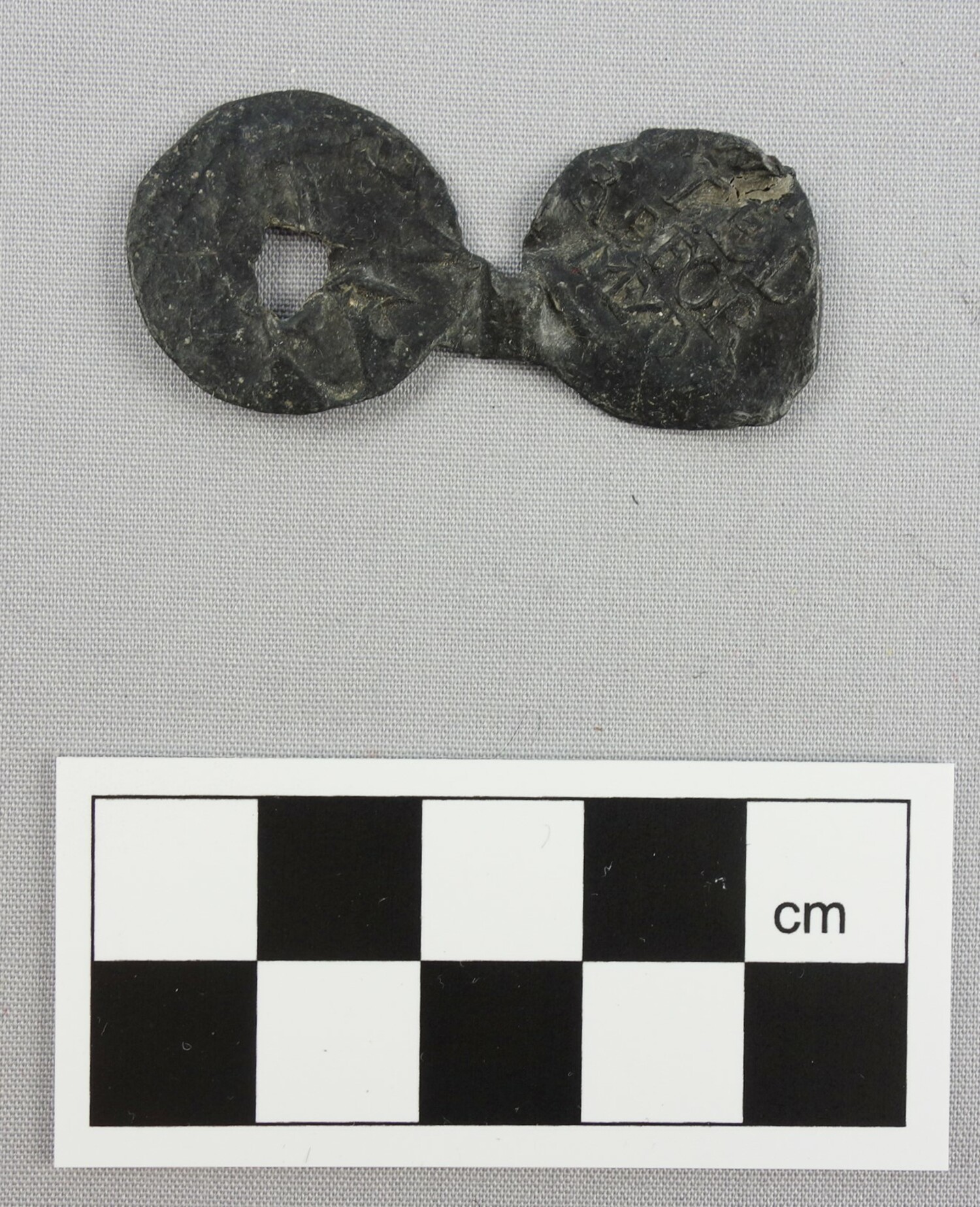 Opened seal with the text: "WORSTED REFORMED" on one side. Norfolk, 17th century (?) (TRC 2016.0111).The fact that worsted and carded textiles were given two different names in seventeenth and eighteenth century Norwich is understandable. They were produced with a different technique, they resulted in a different fabric, and they were used for different purposes.
What intrigues me, as I said before, is whether there are any historical reasons for the term ‘stuff’ being specifically used for worsted wool, and whether there is a link with the Low Countries and the Dutch word stof. Flanders in modern Belgium was well-known for its textile (wool) production since the Middle Ages, and the use of kamgaren (combed wool, the ‘stuff’ of this blog) allegedly expanded rapidly in Flanders in the 13th century.
In the 14th century, the economic policy of the British ruler, Edward III, and political unrest in Flanders led many craftsmen, including weavers and others, to migrate from the continent to Norfolk, and soon East Anglia became the English centre for the production of worsted cloth. In the mid- and late 16th century, more Flemish, Walloonian and other immigrants arrived in East Anglia, generally known as the Strangers from the Low Countries. They are linked to the expansion of the so-called New Draperies and what in the 17th century came to be called Norwich stuff, which, following Ursula Priestley, were “textured and patterned worsted and worsted mixtures, colourful and often highly finished, with a wide range of uses, both for clothing and furnishings.”
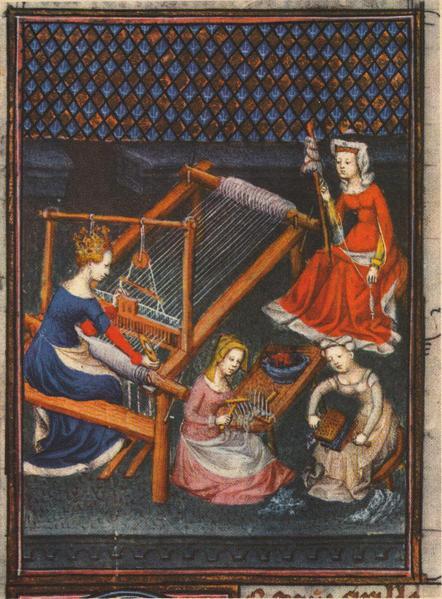 Illustration showing women spinning, carding, combing, and weaving wool. From Giovanni Boccaccio, 1374, 'De mulieribus claris' ('On Famous Women').My question therefore is whether the migrants from Flanders, who may have promoted the production of kamgaren in East Anglia, came to call it stof or stuff, to differentiate it from the coarser, carded textiles traditionally produced in the area.
The Dutch word stof, or medieval Dutch stoffe, for textiles, probably originates in Old French estophe (and Modern French étoffe), itself a derivation of a Frankish (Germanic) word *stopfôn, for ‘filling up’ (compare the modern Dutch verb stoppen for darning or filling, compare the English ‘stuffed’). This meaning of the word is found in that of a form of quilted armour, which was widely used in the Middle Ages in Europe.
Anyhow, all very nice, you might say, but what has that got to do with the price of fish?
The (medieval) Dutch word stof or stoffe for a textile seems to have found its way into German, Danish and Swedish, which would reflect the importance of Dutch/Flemish textile production and export in the Middle Ages and later. So could the same transfer of the word stof or stoffe to the east and northeast also have happened in the opposite direction, across the North Sea, especially when considering the intensive contacts of the Flemish traders and craftspeople with their English counterparts? And could this transfer have focused on a special, somewhat luxurious type that also came to be named after a little village in Norfolk, i.e. Worstead, and which happened to be an economic success story in Flanders?