The TRC exhibition on haori (a Japanese garment worn as a short jacket) is a wonderful banquet of colour and design. What I find most intriguing however, are the linings of the jackets, which often display designs not meant for outsiders to see. These for-your-eyes-only designs raise tantalizing questions. What does it feel like to carry these hidden pictures? What do these designs mean to the wearer?
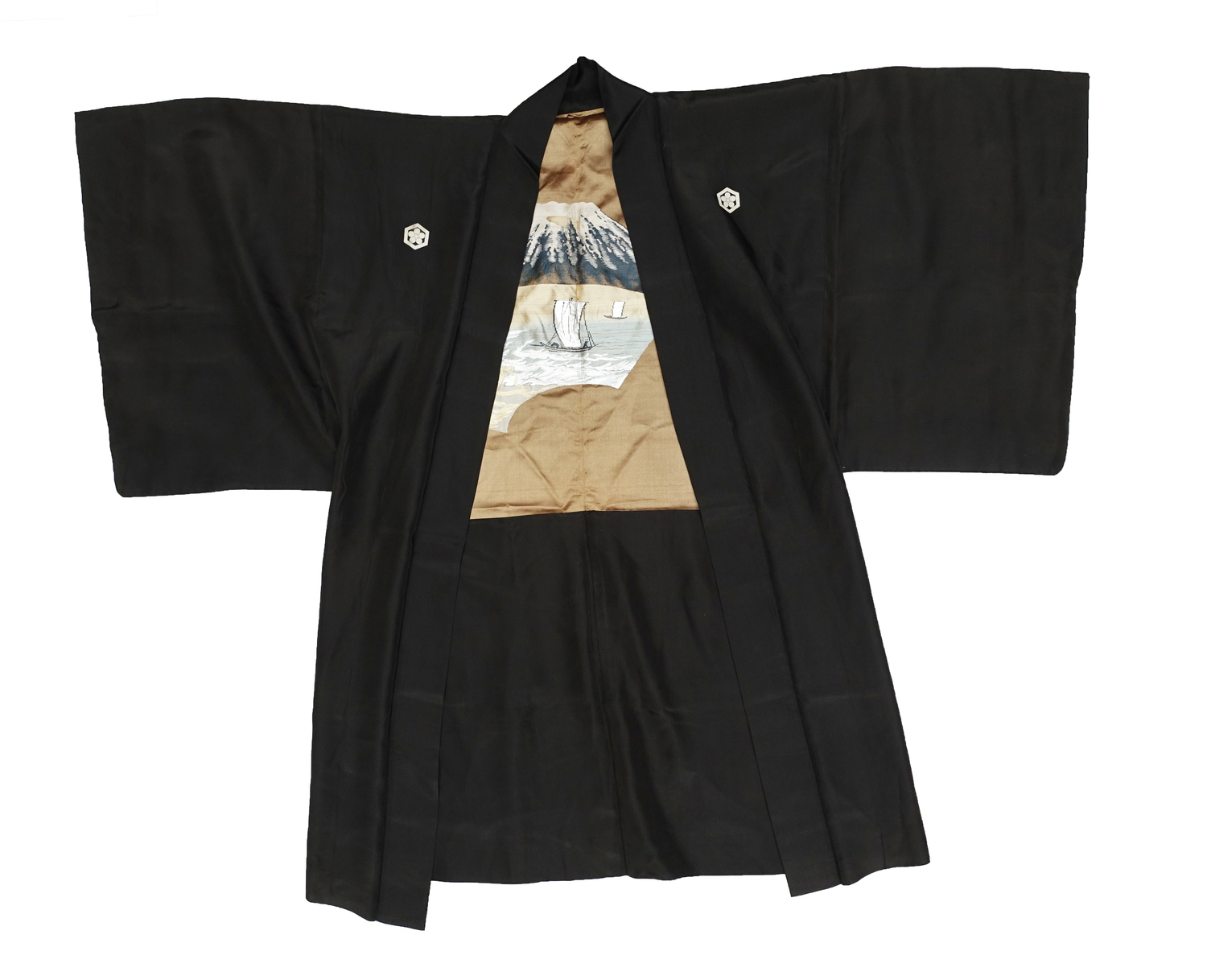 Man's haori with a lining that has a woven design of Mount Fuji. Japan, 20th century (TRC 2024.1052).
These questions make the dozen or so black haori (TRC 2024.1051 to 2024.1066) in the TRC collection so interesting. The haori are mostly made for men, but there are a few for women. These garments are a monochrome black on the outside, sometimes with small, discrete family crests on the back and sleeves.
The linings, however, are another story. Inside are beautiful woven or painted pictures, like two boats sailing in front of Mount Fuji (TRC 2024.1052); or a dragon curved around a volcano (TRC 2024.1054); or a colourful mountain scene and a curled, sleeping cat (TRC 2024.1065). Why did the wearer select these scenes?
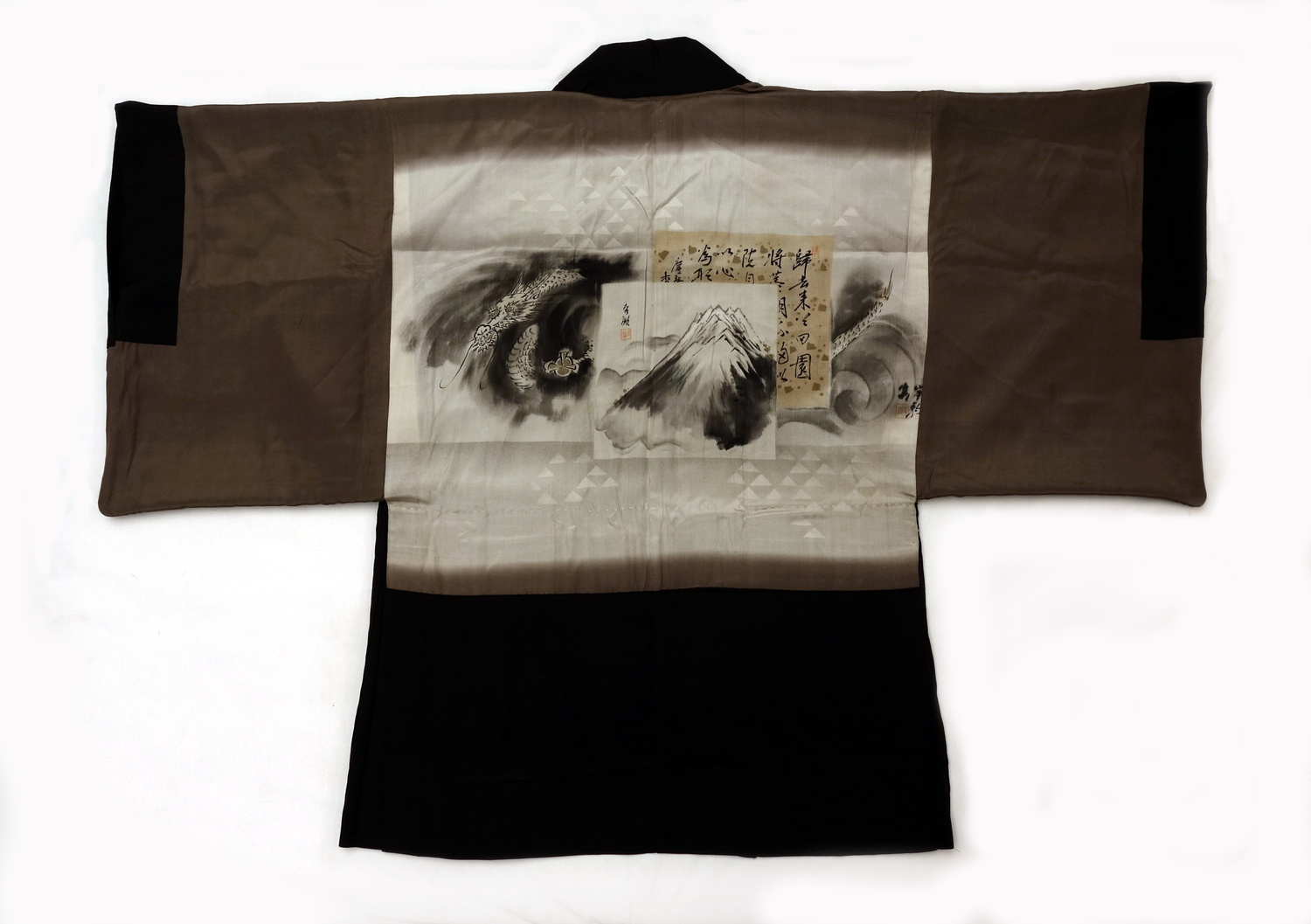 Man's haori from Japan, 20th century, with on the lining a painted design of a volcano (TRC 2024.1054).
Many of these haori were acquired last year, when the TRC conducted a crowdfunding campaign to purchase them. TRC supporters are a generous group of people, so the campaign was a success. As a thank-you, many funders, including myself, received a lovely cotton furoshiki.
My orange coloured furoshiki had a lovely repeating fan motif. But I had never heard of a furoshiki before. What was this squarish-shaped cotton cloth used for? I looked up furoshiki in the TRC’s on-line collection to see two further examples. One had a delicate geometric pattern (TRC 2009.0421), while the other was a green cloth with a rather non-Japanese looking paisley, or buteh, pattern (TRC 2021.2150).


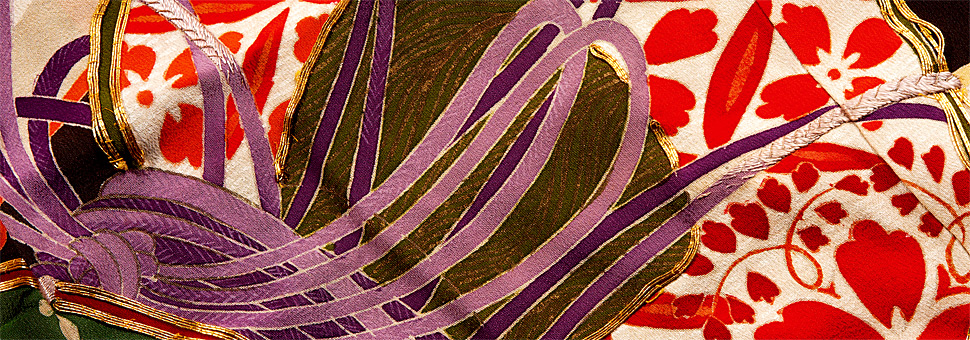

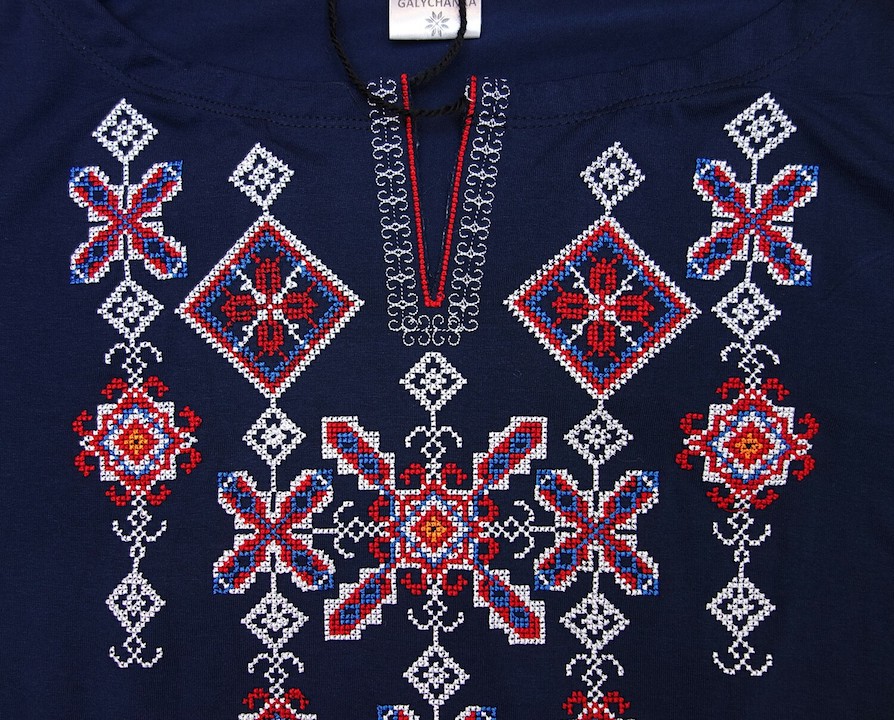 Detail of an embroidered top for a Ukrainian woman, early 21st century. Acquired in 2024 (TRC 2025.0149).